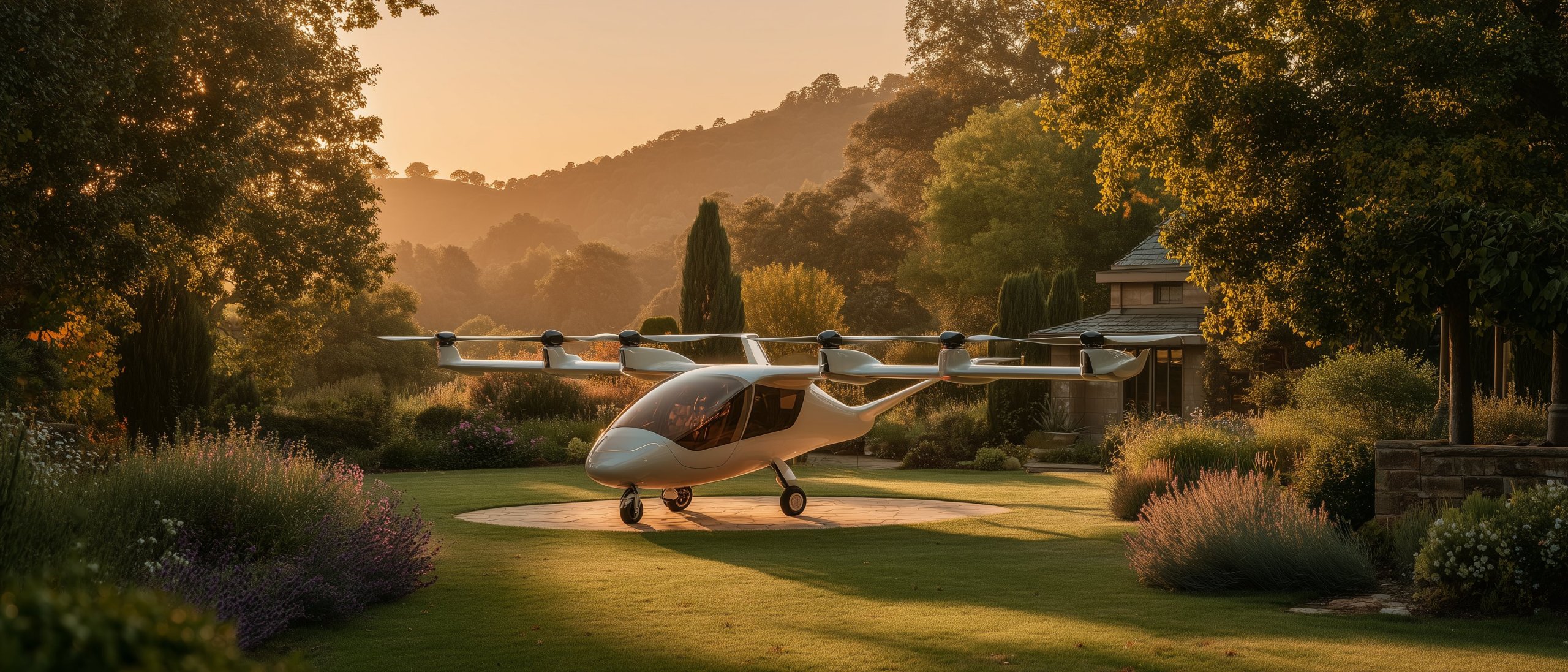
What aviation does for the estate, more than any other category of mobility, is change the scale of distance. The residence is no longer a place the family lives near a particular city or region; it is a place the family lives in a country and a continent. The helicopter brings the regional city into the morning. The eVTOL, as it matures, brings the urban core within a thirty-minute commute that does not touch a road. The seaplane and seaglider open the lake, coastal, and inter-island routes that no other category serves efficiently. Where ground mobility is constrained by roads, traffic, and terrain, aviation operates against geography directly.
The transition underway
What the eVTOL and Helicopter sub-classes describe, read together, is a transition the industry has now committed to: the short-haul executive rotary role that helicopters have occupied for half a century is being progressively taken over by eVTOL, while helicopters retreat to the longer-range, heavier-lift, and bad-weather scenarios where current eVTOL platforms cannot operate. The two categories will coexist for the rest of the decade and well beyond; the balance will shift over time as eVTOL platforms mature, range improves, and the infrastructure scales.
For an estate making aviation infrastructure decisions now, the practical implication is direct. Helicopters remain the right answer for current operational needs. eVTOL platforms are not yet broadly available, not yet proven at scale in private executive service, and not yet matched to all the conditions the helicopter handles well. But the trajectory is clear enough that aviation infrastructure being built now should provision for both — the electrical capacity for megawatt-class eVTOL charging, the pad architecture capable of accommodating both rotorcraft and eVTOL, the regulatory groundwork that allows the transition to happen as platforms become available. The eVTOL roadmap is no longer speculative; it is operational planning.
The short-haul executive rotary role that helicopters have occupied for half a century is being progressively taken over by eVTOL. The two categories will coexist; the balance will shift.
What is estate-resident, what is not
Aviation on a sovereign estate runs across a spectrum from the aircraft housed at the property to the aircraft the family uses through other arrangements. This page covers the first; the rest is treated elsewhere.
Estate-resident aircraft are the helicopter, the eVTOL when the family adopts one, and the seaplane or seaglider where the property has the waterfront for it. These live at the property, are charged or fueled from the estate’s own infrastructure where applicable, are maintained by relationships the household manages directly, and are part of the family’s daily mobility picture rather than a service the family accesses occasionally.
Not estate-resident is the business-jet capability. Full-cabin and light business jets require runway lengths and FBO facilities that even the largest estate cannot provide on-property. The family’s access to business-jet capability runs through fractional ownership (NetJets, Flexjet), charter (VistaJet at the high end), or whole-aircraft ownership with the aircraft based at a regional FBO. The platform side of business aviation is real and consequential, but the operational envelope it produces is treated under Estate aviation on the Destination pillar.
Also not estate-resident is the conventional-airframe regional electric aircraft category — Eviation Alice and its peers — because these require established airstrips the estate does not provide. Where the family uses these, they operate from a regional field on the same fractional or whole-aircraft basis the business jet operates on.
The distinction matters because it shapes what the estate’s aviation infrastructure has to support. A helipad is sized for what lands at the property. An eVTOL pad is engineered for what arrives and departs vertically with megawatt-class charging. A seaplane dock is part of the marine infrastructure with seaplane-specific accommodation. The infrastructure is built for the estate-resident fleet; the family’s relationship with the rest of aviation runs through different arrangements.
The infrastructure commitment
Aviation infrastructure on a sovereign estate is more architecturally consequential than any other Mobility category, and the commitment scales with what the family will operate from the property.
A helipad is the most common form. The pad itself is a designed surface — typically concrete with appropriate markings and lighting — sited for safe approach and departure, with regulatory clearance from the relevant aviation authority. Refueling capability for the turbine-powered helicopters requires fuel storage and handling that has its own regulatory and safety requirements. The pad’s location is part of the estate’s architectural plan from the start; siting it after the fact constrains the residence’s development in ways the family will live with.
An eVTOL pad is a helipad with substantially larger electrical service. The megawatt-class charging that eVTOL operational turnaround requires — recharging a 200 kWh pack in twenty to thirty minutes — is a dedicated electrical service from the estate’s equipment room to the pad, often comparable in capacity to the residence’s entire main service. The pad architecture itself is similar to a helipad but engineered for the eVTOL platforms it will serve: downwash patterns, ground support equipment, charging connectors. Estates planning aviation infrastructure now are increasingly building hybrid pads — helipad surfaces with eVTOL electrical and ground-support provisions ready to activate — rather than committing to one or the other. The electrical capacity reservation during the build is modest; the cost of retrofitting it later is substantial.
A seaplane dock or seaglider berth is the water-side equivalent, shared with the broader marine infrastructure. The dock accommodates the floats or amphibious landing gear; the berth handles the larger seaglider with its retractable hydrofoils. For estates with serious waterfront and a meaningful seaplane or seaglider commitment, the dock infrastructure is specified at design alongside the rest of the marine architecture. The charging requirement for the all-electric seaplane or seaglider is similar in nature to the eVTOL pad’s — substantial electrical service to the waterfront for operational turnaround.
All three commitments are specified at the estate’s site selection and master planning phase. None can be retrofitted easily; each has consequences for the architecture, the energy system, the security envelope, and the family’s daily mobility for decades.
The architectural decisions that matter
Several decisions shape what estate aviation actually is, all of them made before architectural design begins.
Site selection. Whether the estate’s site can accommodate aviation infrastructure at all is the first decision, made at property acquisition. Topography, prevailing winds, neighboring properties and their objections, local regulations, airspace classifications, and — for the seaplane sub-category — waterfront access all shape what is possible. A site with viable approach paths and supportive regulatory context is fundamentally different from one without.
Pad and dock placement. Where on the property the helipad, eVTOL pad, and seaplane dock are sited. The acoustic, visual, and operational consequences of placement are substantial and difficult to revise. Pads are typically sited at distance from the residence’s primary living areas to manage noise. These are master-planning decisions made before architectural design begins.
Hybrid pad provisioning. Given the transition from helicopter to eVTOL now underway, the most consequential single decision in aviation infrastructure is whether to build a hybrid pad — helipad surface with eVTOL electrical capacity and ground-support provisions already in place — rather than committing to one architecture or the other. The cost difference at design time is modest relative to the rest of the aviation infrastructure commitment; the cost of upgrading a pure helipad to eVTOL capability later is order-of-magnitude larger.
Operational and security integration. The aviation infrastructure is integrated with the rest of the estate’s substrate — the pad’s lighting and approach systems, the security perimeter that extends to airside operations, the operations console’s visibility into aircraft state and flight planning. The security envelope around aviation is particularly consequential because the principal’s movements are visible to anyone observing the pad.
Aviation is the category that most extends the estate’s operational reach and most demands of its infrastructure. Done well, it is what makes the residence genuinely a base of operations rather than a destination — the family lives at the estate and works in the region, the country, and the world from it. With the helicopter still dominant and the eVTOL now operationally arriving, the discipline is to build for both: today’s workhorse and tomorrow’s successor, accommodated in one infrastructure that will serve the residence for decades as the balance between them shifts.