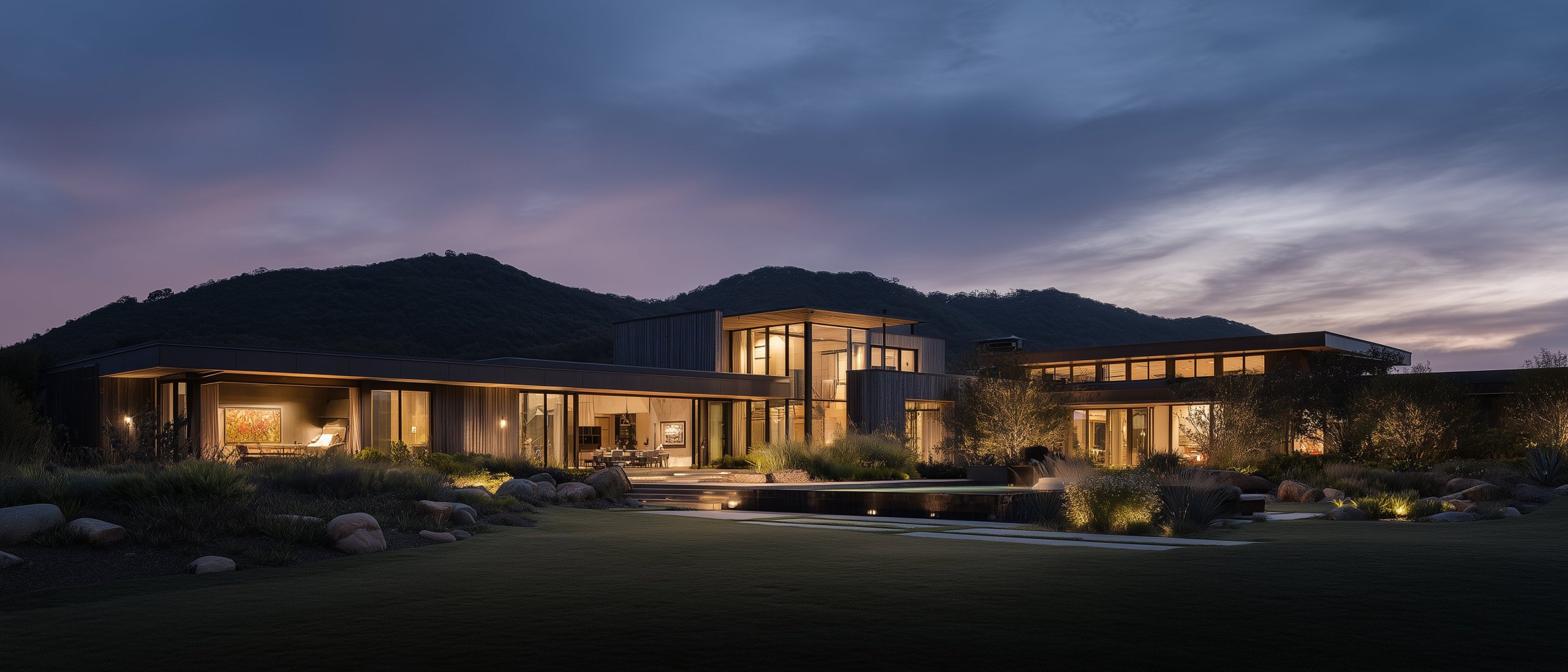
The conventional way of thinking about energy in a luxury residence treats the house as the load and the utility as the supply. The architect specifies the panels and the loads, the electrical engineer sizes the service entrance, the homeowner pays the bill. Solar arrays and home batteries, where present, are accessories — offsets against the bill, with the grid as the operational backbone. On a sovereign estate, the entire frame inverts. The residence generates and stores its own power as a primary capability. The grid, where it exists, is one input among several — useful as a buffer and a long-duration backstop, but not the operational backbone of anything.
What makes this inversion meaningful, and what distinguishes a sovereign-estate energy system from the residential solar-and-battery installations the luxury market increasingly offers, is the second inversion that follows it. The mobility, robotics, and operational loads the estate now carries make the residence’s own electrical demand the smaller half of the system. A fleet of electric hypercars, vehicles in continuous autonomous operation, an eVTOL at a private pad, a tendered electric vessel, a working complement of humanoids — each is a load that, taken alone, would be substantial; together, they routinely exceed the household’s own demand. Layered on top of these are the household-specific loads that no two estates share — a working restoration garage, an estate winery, a maker’s workshop, a working equestrian operation, the on-premises compute that runs the residence’s reasoning layer. The estate’s energy system is being designed to power a fleet operation, a household, and the particular life of one family, not a generic residential load.
The disciplines that produce this kind of system — multi-source generation, multi-string battery storage, intelligent dispatch, sub-second islanding, redundant feeds, N+1 architecture — come from the world of operations where uninterrupted power has been a non-negotiable requirement for decades. What is new is the residential scale at which these disciplines now apply. A sovereign estate’s energy system is microgrid-class engineering at residential scale, run continuously, against a 24/7 reliability standard the residence holds itself to because the family living above it is depending on it without thinking about it. The same disciplines, at adjusted scale, apply to multi-residence family holdings and to luxury resorts whose guests carry the same expectations the family does.
The seven children below resolve this into the working components. Microgrid architecture is the integrating concept. Generation produces. Storage holds. Charging infrastructure handles the fleet. Lifestyle and hobby loads accommodate the particular life of the household. Dispatch and energy management is the operational intelligence layer. Resilience is the discipline that holds against the moment something goes wrong. Each is a system; together they are the system the rest of the estate sits on.