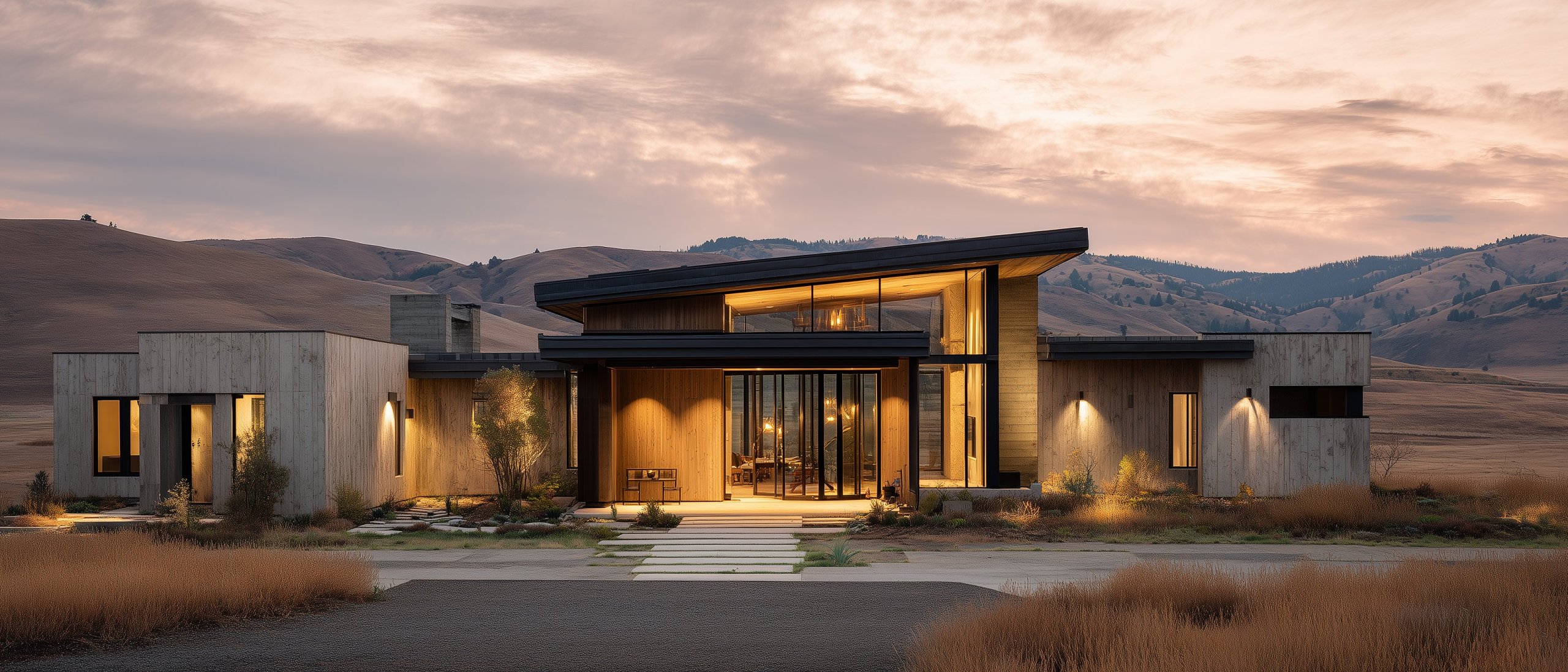
The conventional way of thinking about generation on a residence treats the question as one of technology choice. Solar or wind. Geothermal or natural gas. A roof array or ground-mount. The right answer is presented as a single technology selected for the site. On a sovereign estate, this framing breaks down the moment the load profile is examined seriously, because no single generation technology produces continuously at the scale and reliability the residence and the fleet require. The right framing is therefore not which technology but which portfolio.
Generation on a sovereign estate is the assembled portfolio of sources that produces the estate’s electricity reliably across time, weather, and seasons, designed against the actual load profile the microgrid has to support. Solar produces during sunlit hours. Wind produces when the site has wind. Geothermal produces continuously where the geology supports it. Fuel-based generation produces on demand, for as long as the fuel lasts. None of them produces all the time. The portfolio is what produces all the time, by composition. The discipline of generation is the discipline of designing that composition for one specific estate.
The page that follows resolves this. The three properties of a portfolio. The four roles each source plays. The foundation, the supplements, the long-duration backstops, and the emerging technologies worth tracking. The architectural decisions that matter. And the honest treatment of fuel-based generation, which the sovereign-estate discipline includes deliberately rather than as a compromise.
The three properties of a portfolio
A generation portfolio that meets the sovereign-estate standard has three properties. Each is the test of whether the portfolio actually serves the estate as a power system rather than as a series of installations.
Multi-source by design — the portfolio includes sources with different operational characteristics, so that no single failure mode (cloudy week, mechanical issue with one system, fuel supply interruption, seasonal variation) leaves the estate without generation capability. Multi-source is not redundancy for its own sake; it is the recognition that every generation technology has a window in which it cannot produce, and the portfolio is designed so the windows do not align.
Temporally matched to the load profile — the portfolio is designed against when the estate consumes electricity, not just how much. Solar peaks at midday; the estate’s heaviest loads — evening vehicle returns and fast-charging, eVTOL turnaround, climate at night, the household’s active hours — often occur hours offset from solar peak. Storage bridges this mismatch; generation contributes by adding sources whose production windows differ from solar’s. The temporal matching is what makes the portfolio actually serve the estate.
Designed across three time horizons — the portfolio addresses short-cycle (daily, where solar plus storage carries the residence through nights), medium-cycle (weather events and three-to-seven day low-production periods where storage alone is insufficient), and long-cycle (extended outages, seasonal variability, multi-week scenarios that demand fuel-based or other long-duration sources). A portfolio designed for only one horizon — the daily cycle, typically — is a portfolio that fails the moment the cycle extends beyond its design assumption.
The three properties are interrelated. Multi-source supports temporal matching by adding production windows. Temporal matching reveals where the portfolio needs additional sources. The three time horizons clarify which sources serve which need. A portfolio that satisfies all three is a portfolio designed deliberately; a portfolio that satisfies one or two is a portfolio assembled from market offerings.
The four roles in the portfolio
Within the portfolio, each source plays one of four roles. Naming the roles is what turns a list of technologies into an integrated system.
The foundation — the source that produces the bulk of the estate’s annual energy. On essentially every sovereign estate in 2026, this is solar photovoltaic. The foundation is sized for the estate’s load and is the source that makes the rest of the portfolio possible by carrying the majority of generation duty.
Site-conditional primary supplements — sources that produce substantial energy on the estates where the resource actually exists. Wind on genuinely windy sites. Geothermal on sites with the geology to support a ground-source loop. Micro-hydro where a stream or river crosses the property with adequate head and flow. These are not universal technologies; they are site-specific opportunities that, where present, transform the portfolio.
Long-duration backstops — the sources that produce continuously, on demand, for as long as the fuel lasts. Natural gas, propane, biofuel, hydrogen, and (still common as a starting point) diesel. These are the sources that handle the extended low-renewable periods that storage alone cannot bridge. Every serious sovereign-estate portfolio has a backstop; the question is which one.
Emerging technologies — sources that are not yet primary at sovereign-estate scale but are worth tracking because their viability is changing. Small modular nuclear, solid oxide fuel cells, advanced photovoltaic chemistries, building-integrated PV, waste heat recovery. Mostly future considerations; named here because the multi-decade horizon of an estate makes "what will be viable in 2035" a current design question.
Most sovereign estates resolve to a portfolio of solar (foundation) plus one or two site-conditional supplements plus one long-duration backstop. The composition is small. The deliberation behind each component is what distinguishes the portfolio.
The foundation: solar at sovereign-estate scale
Solar photovoltaic is the foundation of the generation portfolio on almost every sovereign estate built in 2026 and forward, and it is worth being precise about what "at sovereign-estate scale" actually means — because solar at sovereign-estate scale is a meaningfully different technology project than the residential rooftop arrays the term often suggests.
A conventional residential solar installation is in the range of 5 to 15 kW peak. A high-end luxury home with significant roof area and serious commitment to self-supply might reach 30 to 50 kW. A sovereign-estate solar installation is typically in the range of 100 to 500 kW peak, with substantial estates going higher. The reason is the load profile already established — the residence is roughly half of the total, and the fleet, the operational loads, and the lifestyle/hobby loads are the other half. A portfolio designed to carry that load against the multi-decade-horizon storage system requires solar capacity in a range that conventional residential framings do not reach.
At this scale, several decisions become consequential that conventional residential solar can defer.
Roof versus ground-mount versus both — sovereign-estate solar rarely fits on a single roof. Most installations combine roof-mounted arrays (where architecturally accommodated) with ground-mounted arrays on the property, sometimes with tracker systems, sometimes integrated into structures like carports, pergolas, or dedicated solar canopies. The choice has aesthetic, operational, and yield implications. Ground-mount arrays produce more energy per panel because they can be optimally oriented and tilted; roof-mount arrays are constrained by the building’s geometry but use existing structure.
Module technology selection — monocrystalline silicon remains dominant in 2026, with progressively improving cell architectures (TOPCon, heterojunction, increasingly perovskite-silicon tandem) becoming available at commercial scale. The choice of module technology affects efficiency, degradation rate over the 25-to-30-year operational life, and aesthetic options. Cheap modules are not the right answer at sovereign-estate scale; the lifecycle economics favor higher-efficiency, lower-degradation, longer-warrantied modules even at meaningful price premiums.
Tracker versus fixed-tilt — single-axis tracking systems produce 15-to-25% more energy per panel than fixed installations but introduce mechanical complexity, maintenance requirements, and visual movement that some estates find inconsistent with the architectural intent. The decision is engineering versus aesthetic, made deliberately rather than by default.
String architecture and electrical layout — at sovereign-estate scale, the solar array is typically broken into multiple strings on multiple inverters or microinverters, partly for reliability (one string failure does not lose the array) and partly to handle shading patterns that vary across a large installation. The string architecture is part of the system’s redundancy posture, not just an installation detail.
Aesthetic integration — on a sovereign estate, the solar array is part of the architecture. All-black modules, integrated mounting, hidden conduit, and on substantial roof installations, building-integrated photovoltaic options where the panel is the roof. The aesthetic dimension is a real engineering constraint, not a preference, because the array is sized to be visible from anywhere on the property.
Done well, solar at sovereign-estate scale produces the majority of the estate’s annual energy. Done poorly, it produces a fraction of what the installation could and ages out of optimal performance early. The difference is the discipline of design and the seriousness of the equipment selection.
Site-conditional primary supplements
Three generation technologies, where the site actually supports them, can become primary supplements to the solar foundation. The key qualifier is where the site actually supports them — each of these is over-installed on sites where the resource isn’t real, often because the technology is fashionable rather than viable. The discipline is honest site assessment.
Wind — on a site with genuinely strong, consistent wind (annual average above 12-15 mph at the relevant hub height, with reasonable consistency across the year), small wind turbines can produce meaningful energy that often complements solar (wind tends to be strongest at times solar is not). The sites where this is genuinely true are a small subset of where it is sold — large rural properties on ridge lines, coastal properties with consistent onshore winds, high-altitude properties in known wind corridors. The vast majority of luxury sites in suburban or low-wind rural settings do not support viable small wind, regardless of how the installer presents it.
Geothermal — ground-source heat pump systems are not strictly generation (they move thermal energy rather than producing electricity), but they substantially offset the electrical demand for HVAC, which on most estates is the largest household load. A capable geothermal loop, coupled with the residence’s HVAC system, can reduce the estate’s climate-driven electrical demand by 50 to 70 percent. The viability depends on site geology, soil thermal properties, and the architecture’s ability to accommodate the loop field or vertical bores. Where it works, it is one of the most cost-effective interventions in the entire energy system; where it doesn’t, no amount of installation effort makes it work.
Micro-hydro — rare but transformative where the site supports it. A stream or river crossing the property with adequate head (drop in elevation) and flow can produce continuous electricity at significant capacity. Unlike solar and wind, hydro is largely uncorrelated with weather conditions and produces around the clock. On the small subset of estates with viable hydro resources, this technology can become the second-largest source in the portfolio after solar. On estates without it, the option simply does not exist.
None of these is a universal technology. All three are worth evaluating during site assessment, before the architectural design begins, because their presence or absence in the portfolio affects the architecture and the sizing of the rest of the system.
Long-duration backstops: the honest treatment
Every serious sovereign-estate generation portfolio includes a long-duration backstop. This claim is worth being direct about, because much of the luxury-energy market avoids the topic.
The argument is straightforward. Solar and storage carry the estate through the daily cycle and through routine weather variation. Geothermal offsets HVAC demand continuously where it exists. Wind contributes where the site supports it. But none of these handles the scenario the resilience discipline cares about most: extended cloud cover lasting more than the storage system can bridge, a multi-week winter pattern with low solar and high HVAC demand, a hurricane or severe-weather event that damages renewable infrastructure for days or weeks, a grid failure that coincides with an unfavorable weather window. For these scenarios, a source that produces continuously on demand, for as long as the fuel reserves last, is essential. That source is fuel-based generation.
The question for the sovereign estate is not whether to include fuel-based generation; it is which fuel.
Natural gas — the most common choice on estates with utility natural gas service. Generators using natural gas can run for as long as gas is available, which on a maintained utility connection is essentially indefinitely. Capital cost is moderate, fuel cost is low, and the technology is mature. The drawbacks are dependence on the natural gas utility (which can fail in the same regional disasters affecting the electrical grid) and the carbon intensity of natural gas combustion. Suitable for many estates as the primary backstop.
Propane — the choice on sites without natural gas service, and increasingly preferred on grid-vulnerable sites because propane reserves are on-property. A substantial propane tank (1,000 to 5,000 gallons depending on the estate’s requirements) can power the residence and the critical loads through weeks of islanded operation. The drawbacks are fuel cost (higher than natural gas), the visual and spatial accommodation of the tank, and the carbon intensity comparable to natural gas. Common on rural sovereign estates.
Biofuel — biodiesel and renewable diesel blends are available for generators that would otherwise run on conventional diesel. The carbon profile is significantly better than fossil diesel, the technology is fully compatible with existing diesel generators, and the fuel can be stored on-property. The drawbacks are cost, supply-chain reliability (the biofuel market is smaller and less stable than fossil fuel markets), and the same particulate emissions and noise as diesel generation. A reasonable choice for estates committed to lower-carbon long-duration generation while accepting fuel-cost premiums.
Hydrogen — the emerging long-term answer. Hydrogen fuel cells can produce electricity from hydrogen with water as the only byproduct, and hydrogen can be produced on-property from solar electricity and water (green hydrogen) and stored long-term. The technology is moving from demonstration to early commercial availability at residential and small-commercial scales in 2026. Capital cost is currently high, the system is more complex than fuel-combustion generators, and the on-property hydrogen production-and-storage architecture adds engineering depth. For estates with the budget, the multi-decade horizon, and the technology orientation to absorb early-adopter risk, hydrogen represents the long-duration backstop that aligns with full energy sovereignty — nothing arrives at the property except sunlight, water, and outside air.
Diesel — still common as the starting point for many existing estates, and worth naming because it is what is most often actually installed at present. Mature, reliable, and inexpensive in capital terms. The drawbacks — carbon intensity, particulate emissions, fuel-supply concerns, acoustic profile under load — are well understood. For estates upgrading their generation portfolio, the question is usually how to replace diesel rather than how to install it.
The choice of backstop fuel is a deliberate decision that should be made during the energy architecture phase, not assumed by default. The fuel choice affects on-property storage requirements (tank size, refill cadence), spatial accommodation, regulatory compliance, acoustic design, and the estate’s long-term energy sovereignty posture. The discipline is to choose the backstop honestly, sized for the longest plausible islanded scenario, with the architecture designed to accommodate it cleanly.
Every serious sovereign-estate generation portfolio includes a long-duration backstop. The question is not whether, but which fuel — chosen deliberately, sized honestly, accommodated cleanly.
Emerging technologies worth tracking
The multi-decade horizon of a sovereign estate makes “what will be viable in 2035” a current design question. Four emerging generation technologies are worth tracking, not because they are part of most current portfolios, but because the architecture decisions made now should not preclude their later integration.
Small modular nuclear — commercial small modular reactor technology has been advancing through demonstration projects and is approaching the first commercial deployments in the late 2020s. The scale at which SMRs make economic sense is currently above the residential range, but the technology trajectory suggests that smaller, residential-or-campus-scale nuclear generation may become viable on a 10-to-20-year horizon. Estates being designed now will live well into that horizon; the architecture should not foreclose the option.
Solid oxide fuel cells — high-temperature fuel cells that can run on natural gas, biogas, or hydrogen, producing electricity with significantly higher efficiency than combustion generators and with the ability to recover waste heat for thermal demand. Commercial at commercial scales, moving toward residential availability. A potentially superior long-duration backstop technology that may displace combustion generators on premium estates within the decade.
Advanced photovoltaic chemistries — perovskite-silicon tandem cells, multi-junction architectures, and other technologies that promise meaningfully higher efficiency than conventional crystalline silicon. Some are reaching commercial availability in 2026; the technology landscape will continue to evolve. The architectural implication is that an estate’s solar capacity is not fixed at first installation; planning for module-level upgrades over the 30-year life of the array is part of the discipline.
Waste heat recovery and thermal-electric integration — on estates with substantial thermal loads or thermal generation, the recovery of waste heat for additional electrical or thermal output is an emerging architectural opportunity. Combined heat and power systems, organic Rankine cycle generators on waste heat streams, and thermal storage integrated with the electrical system are technologies that may become standard on substantial estates within the next decade.
None of these is required reading for current design. All of them are worth knowing about, because the architecture that allows for future integration is the architecture that ages well.
The architectural decisions that matter
Four decisions in a sovereign-estate generation portfolio have consequences large enough to be surfaced at the principal and family-office level.
The first is portfolio sizing. The portfolio is sized for the estate’s realistic load profile, not for the residence’s alone. The temptation is to size against the household’s baseline and add capacity for vehicles incrementally; the result is a system perpetually playing catch-up as the fleet and the operational loads grow. The discipline is to size for the full mature load profile from the start, including realistic projections for fleet expansion, robotics adoption, and the on-premises compute that will scale as EstateAI capabilities grow. Oversizing slightly is far cheaper than chronic undersizing.
The second is land use and visual integration. Solar arrays, wind turbines, ground-loop fields for geothermal, and fuel storage all require land or visual accommodation. On a substantial estate, the question is where these go and how they are integrated into the landscape. Done deliberately, the generation infrastructure becomes part of the estate’s designed environment — solar canopies as architectural elements, ground-mount arrays integrated into the landscape, wind turbines sited as deliberate features. Done as afterthought, the generation infrastructure becomes visual debt the residence carries forever.
The third is fuel-supply posture. For estates with fuel-based backstops, the on-property fuel reserves determine the islanded endurance. A small propane tank gives the estate a day or two; a substantial one gives weeks. The question of how much islanded endurance the estate intends to support is an explicit decision, made by the family with the operator and the energy designer, not assumed from the contractor’s default specifications.
The fourth is technology refresh trajectory. The generation portfolio installed at commissioning is not the portfolio the estate will have in fifteen years. Solar modules degrade and improve. Long-duration backstop options evolve. New supplement technologies become viable. The architecture should anticipate refresh cycles — expansion capacity in the equipment room, electrical infrastructure sized for future generation additions, structural accommodation for additional solar capacity, fuel system flexibility — rather than treating the initial installation as the permanent answer.
When to specify it
Generation specification begins during feasibility and is settled by design development. The phasing matters because generation choices drive substantial architectural commitments that conventional construction sequencing cannot absorb late.
During feasibility, the site is assessed for the supplement opportunities (wind resource measurement, geothermal geology evaluation, micro-hydro feasibility) that may shift the portfolio composition. The fuel-supply options are evaluated (natural gas service availability, propane delivery logistics, hydrogen production-and-storage feasibility). The portfolio’s rough sizing against the projected load profile is established. These decisions inform site planning and architectural approach.
During schematic design, the portfolio composition is settled and the architectural accommodations are integrated — the solar array layouts (roof, ground, both, integrated), the geothermal loop or bore field placement, the fuel storage location, the equipment-room expansion to handle the generation interfaces. These show up on the architectural drawings, not as fit-out additions.
During design development and construction documents, the specific equipment is selected, the electrical integration is engineered, and the conduit and bus pathways are routed. The generation portfolio appears in the construction documents at the same level of definition as the structural and mechanical packages.
During construction, the generation infrastructure is installed alongside the structural and architectural work, not after them — conduit and structural attachments for solar are part of the framing phase, the ground-mount foundations are placed alongside the site work, the fuel storage is sited and installed during the mechanical phase. Deferring generation work to after substantial completion produces visibly retrofitted infrastructure and substantially higher cost.
During commissioning, the portfolio is brought online source by source, tested individually and in concert, integrated with the microgrid controller, and accepted into operation. Generation is one of the most consequential components of the commissioning checklist, and a portfolio not properly commissioned is a portfolio that will underperform for years before anyone notices.
The generation portfolio is the producing core of the energy system — instrumented through the substrate, modeled in the digital twin, optimized continuously by EstateAI, and operated against the household’s real demand. Done well, it is the source of the estate’s electrical autonomy for thirty years and more.
Explore EstateOpsThe sovereign estate does not choose a generation technology. It assembles a portfolio. Solar produces during the day; supplements contribute where the site supports them; long-duration backstops handle the moments nothing else is producing. The portfolio is sized for the residence and the fleet, integrated into the architecture deliberately, and refreshed across the decades the family lives in the residence. What makes it a sovereign-estate generation portfolio rather than a luxury solar installation is the seriousness with which all four parts are designed together as one producing system.