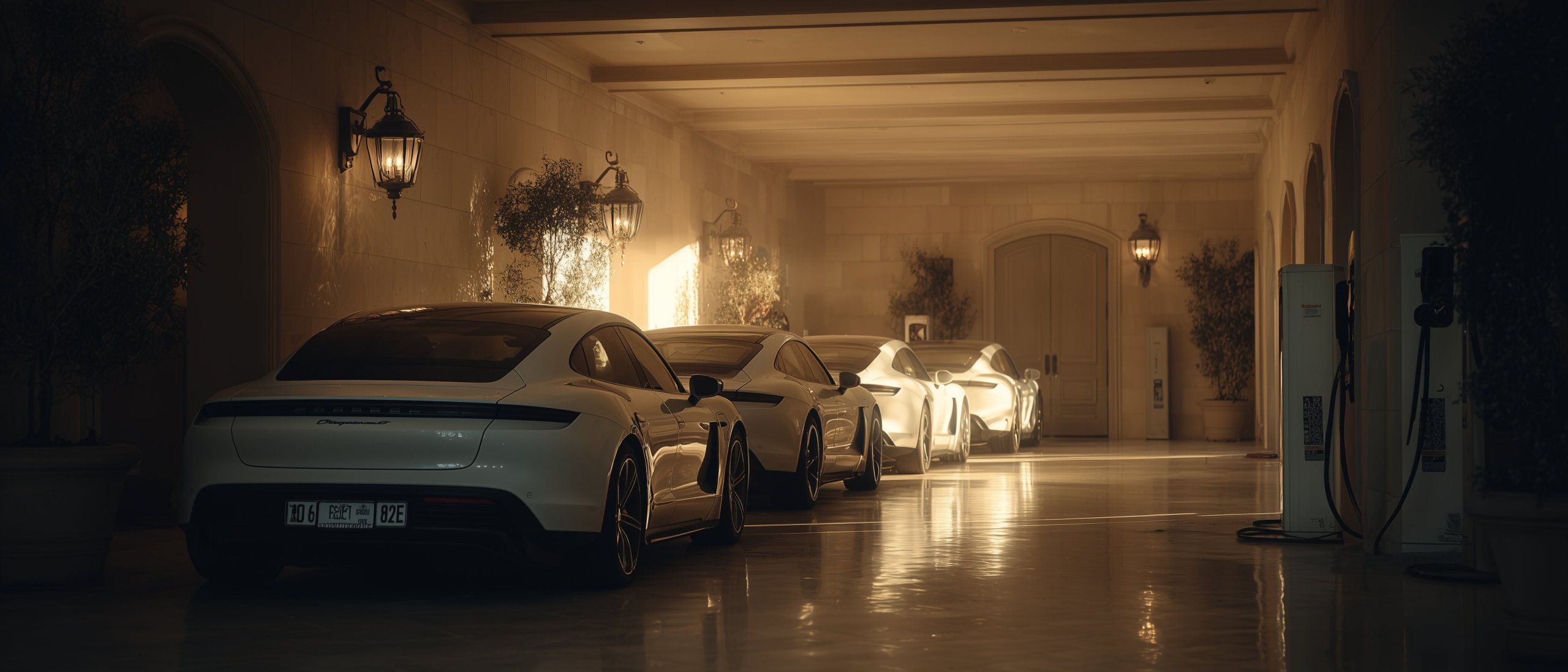
The five sub-classes
The garage at this level resolves into five working sub-classes, each with its own acquisition logic, use pattern, and relationship with the family. Curated profiles of the apex exemplars in each sub-class live on the Showcase hub; the sub-class names below link directly to those collections.
Hypercars. The apex of the garage — the Rimac Nevera, the Lotus Evija, the Pininfarina Battista, the Aspark Owl, the Bugatti Tourbillon, and the small set of successors arriving across the late 2020s. Production runs in the dozens to low hundreds, acquisition is by allocation and relationship cultivated across multiple prior acquisitions, and the cars are used occasionally and maintained meticulously. The category most closely associated with the racing lens, with substantial overlap between hypercar ownership and club-racing participation.
Grand tourers. The cars for distance with comfort — the Rolls-Royce Spectre, the Lotus Emeya, the Mercedes-Maybach EQS, the coming Bentley flagship, and the new wave of bespoke electric GTs. The category for the cross-country journey, the inter-residence trip, and the long road that is its own pleasure. Where the hypercar is acquired for what it can do, the grand tourer is acquired for how it makes the principal feel across hundreds of miles. Comfort and luxury dominate the selection lens; performance is present but never primary.
Performance sedans & coupes. The daily-driver class with character — the Lucid Air Sapphire, the Porsche Taycan Turbo S, the BMW i7 M, the Tesla Model S Plaid, and the increasing set of electric performance sedans approaching genuine driver engagement. The category the household uses most actively, often serving the principal’s daily commute or short-distance work travel. Acquisition logic favors substantive driver engagement combined with the comfort and isolation appropriate to extended daily use.
Luxury SUVs. The family vehicle, scaled — the Rolls-Royce SUV, the Range Rover BEV, the Mercedes-Maybach EQS SUV, the Bentley Bentayga BEV, the Cadillac Escalade IQ, and the Lucid Gravity. The category for the family movement that has to be effortless, where space and isolation matter more than ultimate performance. Often the most-used vehicle in the household over a typical week, balancing the principal’s family-life needs with the brand and quality position the rest of the garage establishes.
Limited editions & bespoke. The cars that exist in single-digit numbers because they were built to specific families’ orders — Rolls-Royce Coachbuild commissions, Aston Martin Q programs, Bentley Mulliner one-offs, the Pagani Codalunga series, and the small number of true coachbuilders producing vehicles to private commission. The acquisition is a multi-year relationship-cultivation process rather than a transaction; the configuration restraint discussed below applies with particular force at this tier; and the resulting vehicle is, more than any other, an extension of the family’s identity into mobility.
What unifies the category above is not a single technology, a single use case, or a single class of vehicle. It is the relationship: these are the cars the family has chosen, one by one, for what each does that no other does. A hypercar acquired for the experience of driving it; a grand tourer for the cross-country journey; a performance sedan for the daily commute the principal looks forward to; a luxury SUV for the family movement that has to be effortless; a bespoke commission for the relationship the family has built with a particular manufacturer. The garage is a curated set of these decisions, and the curation reflects the family’s actual taste rather than a single architectural intent.
The two lenses
Cars at this level are chosen through two lenses that often apply to the same vehicle, in different proportions across the garage.
Comfort and luxury is the dominant lens. The car is engineered to make the journey effortless — acceleration immediately available, suspension absorbing the road, a cabin that stays serene at any speed, materials and finishes the family lives with day after day. This is the lens through which most cars in the garage are chosen, including most hypercars in actual use. The family that owns a Rimac Nevera does not race it weekly; they drive it occasionally and enjoy the capability without needing to exercise it. Comfort and luxury is the relationship most of these cars have with their owners most of the time.
Racing is the adjacent pursuit. A meaningful subset of the cars at this level are also chosen, partly, for the racing relationship they enable — track days at private circuits, manufacturer-organized invitational events, concours-adjacent racing. The racing lens is not about the car as a daily object; it is about the car as a relationship to a particular community and a particular kind of driving. The cars chosen partly for this lens are often the hypercars and limited editions, with the relationship developed through club memberships, instructor relationships, and the long-term cultivation of access that distinguishes a serious participant from an occasional visitor.
The two lenses are not mutually exclusive. A car can be primarily comfort-leaned with occasional track use, or primarily racing-acquired with comfort retained for the occasional road drive. The discipline is to understand which lens dominates the choice and to specify the car’s configuration, maintenance schedule, and use pattern accordingly. A racing-leaned hypercar gets a different tire program, a different alignment cadence, and a different relationship with the manufacturer’s racing arm than a comfort-leaned example of the same model.
The racing pursuit itself — the circuits, the clubs, the manufacturer race programs, the social and competitive context — is treated under Sovereign memberships on the Destination pillar, where the broader vetted-club architecture sits. This page addresses the cars themselves; the racing relationship that some cars also enable is the bridge into that wider treatment.
The selection discipline
What distinguishes a thoughtfully assembled garage at this level from a wealthy one is the selection discipline applied across the sub-categories.
Fit-to-use. Each car has a clear role in the family’s actual life. The hypercar that gets driven six times a year is one thing; the hypercar that sits unused while the family takes the SUV is something else, and the second pattern produces a garage that ages poorly. Cars chosen with a real use in mind hold their value better, develop better operational character, and serve the family rather than burdening the operator with maintenance of unused assets.
Relationship cultivation. At this level of the market, access to specific vehicles depends on the family’s relationship with the manufacturer. Pagani, Koenigsegg, and the upper Ferrari and Porsche programs allocate to known customers first. The bespoke programs require a multi-decade trajectory of acquisitions before a true one-off becomes possible. The relationship is itself part of what the family is acquiring, and the discipline includes the long-term cultivation of those relationships across years and across the residences and family offices that hold them.
Configuration restraint. The temptation, at the bespoke and limited-edition end, is to specify every available option. The discipline is to specify deliberately, knowing the car will be lived with for decades and that aesthetic decisions made for novelty age differently than decisions made for permanence. The best-aging coachbuilt vehicles are typically the ones whose original commissioning specifications were restrained; the worst are the ones whose every available customization was selected. This is the same discipline that applies to the residence’s architectural choices, extended to the garage.
What unifies the category is not a single technology or a single use case. It is the relationship: these are the cars the family has chosen, one by one, for what each does that no other does.
The garage and the rest of the estate
The cars in this category integrate with the rest of the estate’s systems in specific and consequential ways. Charging is served by the estate’s own charging infrastructure — Level 2 connectors at every bay for overnight charging, one or two DC fast-charge positions for the hypercars when fast turnaround is needed, the storage-buffered architecture that handles peak loads without surprising the household. The cars are integrated into the estate’s substrate through their vehicle telemetry, the garage’s environmental monitoring, and the operations console’s visibility into fleet readiness. The garage itself is climate-controlled with humidity discipline appropriate to the cars it houses — particularly for the hypercars and limited editions, environmental conditions matter as much as mechanical maintenance. And the garage is part of the estate’s security operations envelope, with the access controls, monitoring, and protocols that the value of its contents warrants.
The honest acknowledgment of legacy
Most serious garages at this level contain internal-combustion cars alongside the electric. Often these are the legacy of an earlier generation of acquisitions — the family’s grandfather’s 1967 Ferrari 275 GTB, the principal’s late-1990s Porsche 993, the small collection of vintage cars maintained for the relationship with the marque and the era. Many are also more recent — the family’s 2018 Aston Martin Vanquish, the 2022 Lamborghini Aventador Ultimae — that the family acquired when electric alternatives in those categories did not yet exist.
This page is about the electric category that is now dominant in new acquisitions. The legacy cars are part of most garages and will be for decades, and they have their own operational considerations — fuel storage and supply, exhaust ventilation in the garage, maintenance relationships with specialty shops for older marques, the increasing rarity of parts and service knowledge as those generations of cars age. The operator’s discipline accommodates them. They are not this page’s focus, but their existence is part of the honest accounting of what a serious garage actually contains.
The architectural decisions that matter
Garage program. The size, the bay count, the layout, the relationship between display and working space. A garage planned for the current fleet is a garage that will be inadequate within a decade as the fleet evolves. Planning for fleet growth, for the bespoke commissions that may arrive in years to come, and for the working space that maintenance and detailing actually require, is the difference between a garage the family lives with well and one the family wishes were larger.
Climate and protection. The HVAC system serving the garage, the humidity discipline, the air filtration, the UV protection on glazing, the lighting strategy. These are architectural and mechanical decisions made during design; retrofitting them is expensive and rarely produces the same quality as building them in. The garage is treated as an architecturally significant room rather than a utility space.
The charging architecture. Addressed in depth at charging infrastructure, with the consequence for the garage being concrete: one connector per bay, deliberate placement that does not interfere with the cars, conduit and electrical service planned for the future fleet rather than the present one, and the DC fast-charge positions sited for the hypercars they will serve.
The working space. Many sovereign-estate garages include a working area — lifts, workbenches, the equipment for routine maintenance and detailing that the family or staff perform on-property rather than sending out. The working area is distinct from the bay-storage area, and on substantial estates it may be a separate room or structure. The decision of whether to include working space, and at what scale, is made during design based on whether the principal genuinely engages with the cars mechanically or prefers to leave that work to specialists. Where the principal does engage mechanically, this overlaps with the working-garage discussion on working and pursuit loads.