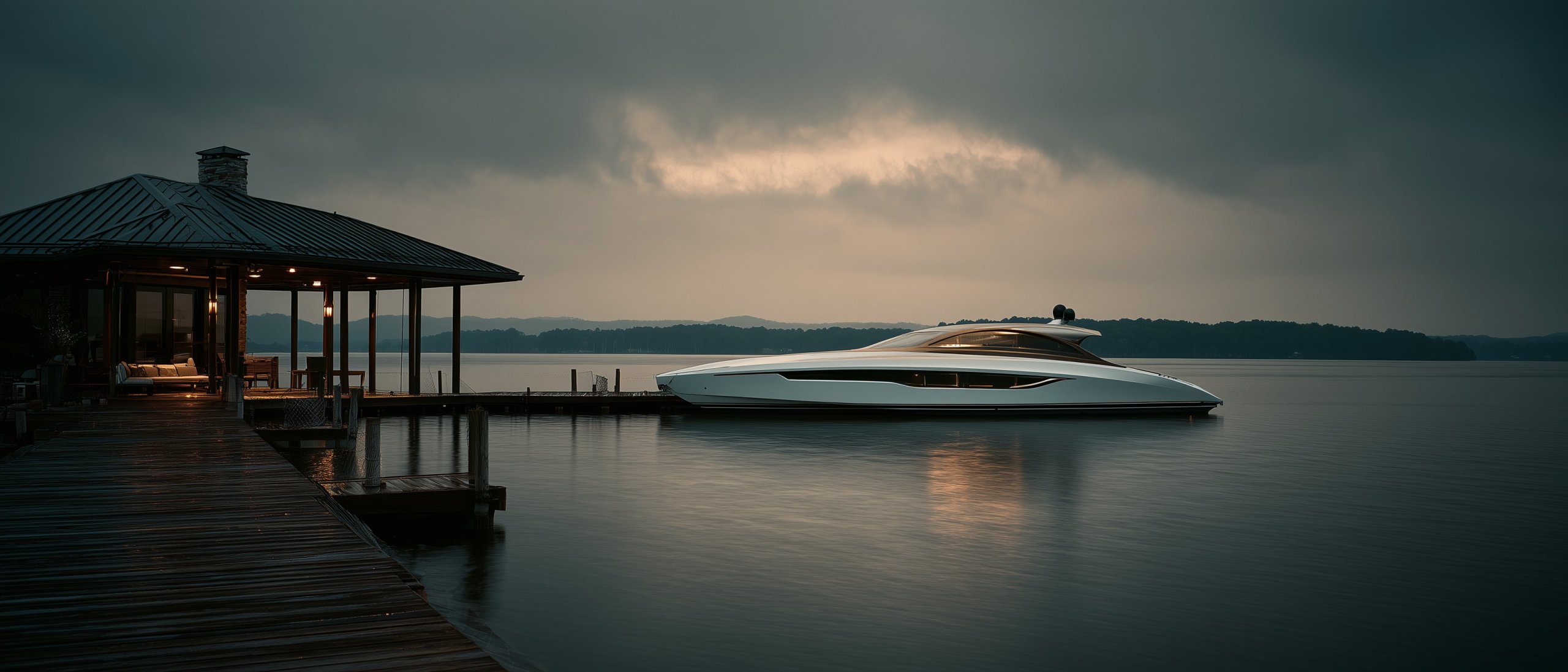
What marine does for the estate is more layered than the other Mobility categories. The car extends the family’s range across land. The aircraft extends it across distance. The yacht does something different: it makes the water itself part of the estate’s life, not just a connector between places but a destination, a working environment, and on the larger vessels, a moving residence. The motor yacht anchored off the estate’s dock at dawn is a different kind of object than the car in the garage. The same family lives in both, but the relationship to each is structurally different.
Marine also carries the longest tradition of any Mobility category on a sovereign estate. Yacht ownership at the family-residence scale has run for over two centuries; many of the institutional frameworks (the yacht clubs, the racing traditions, the brokerage and crewing infrastructure) date from the 19th century and have evolved continuously since. Where cars and aviation are categories the sovereign-estate family enters into a relatively young ecosystem, marine is a category where the family enters an old one — with all the access, exclusivity, and history that implies. The membership and destination architecture that surrounds marine — yacht clubs, racing circuits, cruising stations, the Mediterranean and Caribbean seasons — is treated on the Destination pillar.
The propulsion transition
Marine is the Mobility category where propulsion transition is most visible and where the constraints are most genuinely binding. The transition runs through four stages. Diesel remains the operational standard for serious cruising vessels because nothing else yet matches the energy density and operational endurance required for multi-day passages at displacement speeds. Hybrid diesel-electric is the dominant new-build configuration for premium motor yachts, with the diesels providing extended range and the electric components handling silent low-speed cruising, hotel loads at anchor, and emissions-free operation in restricted waters. Fully electric has arrived at smaller and mid-size scales, dominating the day-boat and tender segment and now an established presence at the catamaran-yacht scale, with solar augmentation extending usable range where the vessel’s deck area supports it. Methanol fuel cells and hydrogen are entering at the largest yacht scales as the first plausible answer to the energy-density question that pure electric cannot yet solve for serious cruising vessels.
Three drivers, not one, are pushing the transition. The first is regulatory: bans on two-stroke ICE engines on freshwater lakes are accelerating across North America and Europe, and restricted-emissions zones in major ports and harbors are expanding. The second is operational: instant torque for tow-sports, silent cruising at low speeds, zero hotel-load emissions at anchor, and lower maintenance overhead (no fuel system, no exhaust, dramatically less mechanical complexity) are advantages the family experiences directly. The third is the environmental dimension that the electric vessel inherits structurally from its propulsion architecture — the dimension most often emphasized in discussion and probably the least decisive of the three for the sovereign-estate buyer in practice.
The propulsion transition is genuine and well underway, but the constraints are real. The estate provisioning marine infrastructure now is building for the transition rather than betting the fleet on it.
Autonomy in marine
Autonomous operation is arriving in marine at a different pace than in ground vehicles or aviation. The current generation of marine autonomy — led by Avikus (the HD Hyundai subsidiary), with NEUBOAT Control launching commercially and integration partnerships with Honda Marine and Raymarine in active rollout — is Level 2 autonomy: assisted piloting, automated docking, real-time collision avoidance, adaptive cruise control, and station-keeping. A certified officer must maintain a safe navigational watch at all times; the system is workload reduction rather than replacement.
For the estate’s marine fleet, the practical implications are real but bounded. Docking assistance handles the close-quarters maneuvering that even experienced captains find demanding in crowded marinas. Collision avoidance reduces risk during routine passages. Station-keeping (the ability to hold position automatically against wind and current) is genuinely useful at anchor or while waiting for a slip. Fully autonomous yacht operation — a vessel making a passage with no human watch — remains years away from regulatory acceptance and probably longer from operational adoption, even where the technology becomes capable. The trajectory is comparable to where automotive autonomy was a decade ago: real capability arriving in well-defined situations, broad autonomous operation still future.
What is estate-resident, what is not
The estate-resident distinction applies in marine, though less sharply than in aviation.
The clear estate-resident vessels are the day boats, tenders, and smaller motor yachts that dock at the estate’s own waterfront and operate from it as the home berth. These charge from the estate’s marine charging infrastructure, are maintained through relationships the household manages directly, and are part of the family’s daily mobility from the property. A 25m motor yacht at the estate’s dock is estate-resident in the same way a hypercar in the garage is.
The larger motor yachts and the serious sailing yachts often operate from a marina rather than the estate’s own waterfront, because the depth, dock infrastructure, and operational support a 50m+ vessel requires exceed what most private waterfronts can provide. These vessels remain part of the family’s marine fleet but the relationship is closer to that of the business jet in aviation: owned but based off-property, accessed through travel to the marina, supported by a captain and crew rather than by the estate’s own staff. The largest superyachts in this pattern often operate in the family’s seasonal Mediterranean, Caribbean, or Pacific rotation, with the vessel positioned in the regions the family travels through rather than the region the residence is in.
The distinction shapes what the estate’s marine infrastructure has to provide. A dock for a 30m motor yacht and a fleet of day boats is one architectural commitment. A deep-water berth capable of accommodating a 60m or 80m vessel is something else, and few estate sites can support it without substantial dredging and structural work. The estates that do have full deep-water marine infrastructure (those with natural deep-water frontage) are among the most marine-active in the sovereign-estate market.
The infrastructure commitment
Marine infrastructure on a sovereign estate is determined largely by site geography but shaped substantially by design decisions during the build.
Waterfront infrastructure. What the estate’s shoreline actually supports. Dock length, depth at the dock, slip configuration, marina-grade or yacht-grade construction standard, protection from weather and wave action. An estate with viable deep-water frontage that builds only a shallow-draft day-boat dock is leaving substantial mobility capability on the table; an estate that overbuilds for vessels it will never own is committing capital to architecture that does not serve. The discipline is to size the waterfront to the genuine estate-resident fleet, not to the broader marine ambition.
Electrical and fuel service. Marine charging for the electric day boats, the hybrid yacht’s battery bank, and the larger yacht’s hotel loads at the dock run from dedicated service that extends from the residence’s equipment room to the waterfront. The diesel and hybrid vessels that will continue to operate alongside the electric ones for years require fuel storage and regulatory-compliant handling. The full electrical and fuel architecture for the marine fleet is treated alongside the rest of the estate’s power and energy systems on charging infrastructure; the marine-specific aspects are dock-side service routing, weatherproof connector specification, and fuel storage compliance with maritime jurisdictions.
Hangar, hard standing, and lift facilities. Where the day boats and tenders are stored when not in the water. Boat houses, dry stacks, marine lifts, the working area for routine maintenance. The smaller vessels typically come out of the water seasonally or for service; the architecture has to accommodate the lift cycles and the on-shore storage that follows. The larger yachts typically remain in the water year-round but require haul-out for periodic service at a separate facility.
Operational and security integration. The marine infrastructure is part of the estate’s substrate through the dock’s sensors, the vessels’ telemetry integration where available, and the security operations coverage that extends to the waterfront. Marine security is structurally distinct from land security — the perimeter is water rather than fence, approaches are from any direction, response time considerations differ — and is addressed accordingly in the broader security architecture.
The architectural decisions that matter
Site selection and the marine envelope. Whether the estate’s site can support marine activity at all is set at property acquisition. Waterfront access, depth at the natural shoreline, protection from prevailing weather, regulatory context for dock and waterfront development — all shape what is possible. The distinction between waterfront-capable and merely-water-adjacent properties is large; most sovereign-estate marine operations work because the site supports them naturally.
Estate-resident fleet sizing. What the family will actually keep at the property versus what operates from marinas. The waterfront is sized to the estate-resident fleet, not to the family’s broader marine activity. Building for a 60m vessel that will live at a Mediterranean marina anyway is overbuilding; building for only a small day-boat fleet when the family genuinely wants a 30m motor yacht at the estate is underbuilding. The honest sizing decision precedes the dock construction.
Propulsion-mix accommodation. The marine fleet contains both electric and combustion-engine vessels and will for years to come. The waterfront has to host both — charging service for the electric segment, fuel storage and dispensing for the diesel and hybrid vessels, ventilation and safety considerations for the working area where both are maintained. The architectural decision is not whether to choose one or the other but how to host both reliably across the multi-decade life of the estate’s marine commitment.
Operational integration with the estate substrate. The dock, the vessels, the security perimeter, and the operations console’s visibility into fleet readiness are one integrated system rather than a marine system bolted alongside the rest of the estate. The integration is set during design and commissioning, not retrofitted afterward.
Marine is the category that connects the estate to the water that defines its location, whether that water is a coast, a lake, or a river system. The vessels at the waterfront are part of the residence’s life in a way the cars in the garage are not — the family lives with the water, and the marine fleet is what makes that life genuinely operational across the seasons the family is present and the destinations the water reaches.