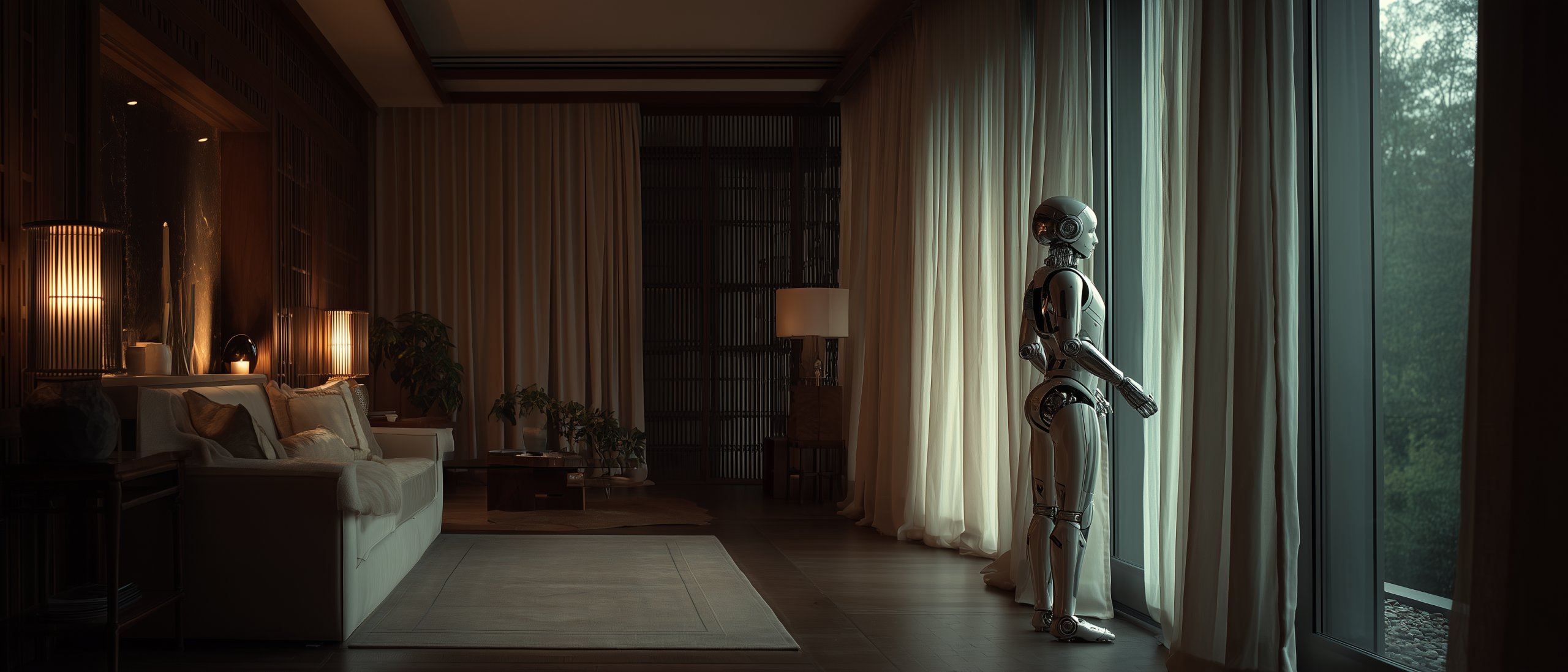
Everything else in the Intelligence system is a mind without hands. Automation moves the fixed systems of the building; EstateAI supplies the judgment. Robotics is what lets the estate change the physical world directly, the layer arriving fastest and least evenly. Some forms are mature and unremarkable; others are genuinely new and still finding their footing on the estate. The useful thing is to separate them by what they actually are, rather than by the excitement around the word “robot.”
The forms embodied intelligence takes
Estate robotics is not one thing. It spans a range from the utterly routine to the genuinely novel, and an estate will use several at once.
Task robots. Single-purpose machines that already work well — robotic mowers, pool cleaners, floor and window machines. Mature, quiet, and largely invisible. The established floor of estate robotics, not its frontier.
Mobile platforms. Wheeled or tracked machines that move through the estate carrying sensors, supplies, or security functions. Delivery within a large property, grounds patrol, transport between buildings. Capable, increasingly autonomous, and well suited to estates with distance to cover.
Aerial drones. For survey, security, and the monitoring of grounds too large to watch from the ground. A perimeter seen from above, a roof inspected without scaffolding, a property understood as a whole. Powerful, and the form with the sharpest privacy and airspace considerations.
Humanoids. General-purpose machines built to operate in spaces designed for people, and to take on the open-ended physical work that single-purpose machines cannot. The newest form, the most capable in principle, and the least settled in practice. This is the frontier, and it deserves to be understood as such rather than oversold.
The honest position on humanoids
Humanoids are the form that draws the attention, so they deserve the most candid treatment. The case for them is real: a machine shaped like a person can use a house built for people — the same stairs, doors, tools, and surfaces — without the estate being rebuilt around it. That generality is the whole promise.
The honest qualification is equally real. The technology is early, genuinely capable general-purpose home humanoids are only beginning to arrive, and an estate adopting them now is adopting a frontier, not a settled appliance. The mature move is to treat humanoids as an emerging capability to plan for and adopt deliberately — not to either dismiss them or to over-rely on them before they have earned it. An estate built to integrate them as they mature is positioned well; an estate betting its operation on today’s versions is not.
The estate that prepares for embodied intelligence will adopt it gracefully. The estate that waits will retrofit it awkwardly.
The question robotics forces: staffing and trust
Embodied machines raise a question the other intelligence layers do not, because they step into work that people have always done on an estate. The serious version of the question is not “robots versus staff” — it is how the two compose. Machines absorb the repetitive, the physical, and the around-the-clock; people remain for the judgment, the discretion, and the human presence that no machine supplies. A well-run estate uses robotics to let its staff do the work only people can do, not to manufacture an empty house.
There is also a trust dimension specific to embodied machines: a robot that moves through the residence, sees its rooms, and acts within it is, like every other sensing system, a question of who controls what it perceives and records. That places robotics squarely against data sovereignty — a machine in the home is only as trustworthy as the family’s control over what it knows.
Robotics is selected, integrated with the estate’s staff and systems, and supervised in operation through the operations console — the machines are run as part of the household, not dropped into it.
Explore EstateOpsRobotics is where the estate’s intelligence acquires a body. Adopted with judgment — the mature forms used fully, the frontier forms planned for honestly — it is what lets a sovereign estate do its own physical work, on its own terms.