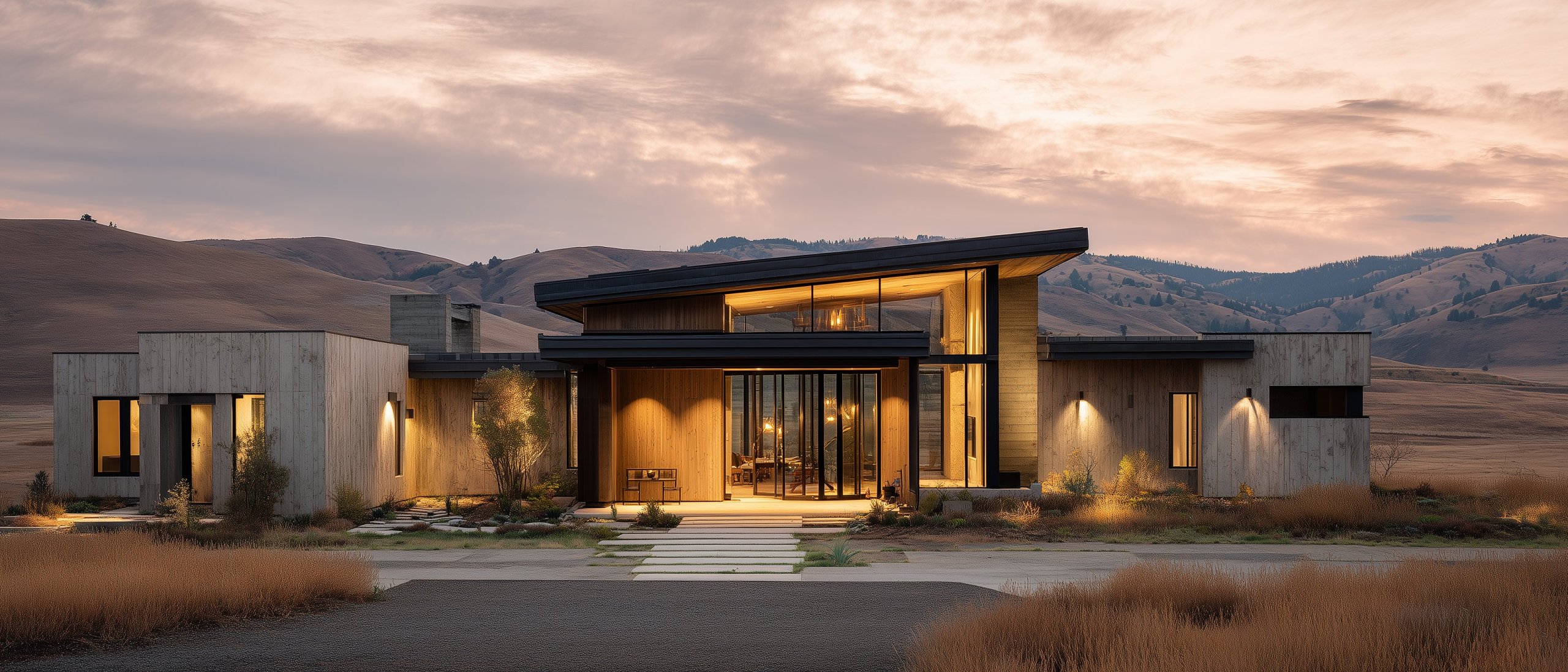
At sovereign-estate scale, the family operating from a single residence is the exception rather than the rule. The principal who maintains a primary estate, an apartment in a major financial city, a coastal property where the yacht spends the summer, and a country property held across generations is operating four residences whose coordination is itself a substantial discipline. The composition varies by family; the multi-property pattern is consistent.
The four are not four separate homes that happen to share an owner. They are four expressions of a single sovereign envelope, extended across geography. The substrate that runs the primary residence — the cognitive layer, the data sovereignty architecture, the security perception, the connectivity — extends to the family wherever the family is in the portfolio. The standards the family operates by apply at every residence. The operations console presents the portfolio as a single picture rather than as a stack of per-property pictures.
The continuity does not happen by default. It is the result of architectural decisions made when each property is acquired or built, and operational decisions made continuously across the portfolio. A family with four residences operating as four independent installations has four homes. A family with four residences operating as one envelope has a multi-property estate.
The substrate that extends
The four disciplines treated under Intelligence are what operate as the envelope’s extension across the portfolio. The architectural posture is consistent: each discipline operates at portfolio scale rather than as repeated per-property installations.
The cognitive layer. Each property maintains its own local compute infrastructure running the household’s foundation models. The fine-tuned reasoning that has learned the family’s patterns synchronizes across the portfolio over encrypted infrastructure the household controls. The family interacts with one cognitive layer regardless of which residence they are in; the household’s accumulated configuration travels with them.
Data sovereignty. The household’s data lives on the family’s compute across the portfolio rather than aggregating in a vendor’s cloud. The encrypted-tunnel architecture connects the properties’ compute infrastructure into a coherent whole. Backup and redundancy operate at portfolio scale — the secondary property’s compute backs up the primary’s data, with cross-property redundancy providing resilience that single-site backup cannot.
Security continuity. The operations console presents the household’s overall picture across every property simultaneously. The threat-model engineering operates against the family’s overall threat picture rather than a property-specific one. Protocols apply consistently. The integrators and security partners the household engages operate portfolio-wide where they have the footprint to do so; where they do not, the household engages multiple partners with the coordination discipline that maintains consistent standards.
Connectivity. Each property runs its own multi-path architecture (fiber, LEO satellite, cellular) per the standard treated in Connectivity. The properties connect to each other through encrypted tunnels operating on the family’s sovereign overlay rather than through public services directly. The household’s compute, data, and operational systems communicate across the portfolio over infrastructure the household controls.
The substrate is not synchronized across properties by a vendor’s cloud. It is connected by the family’s own network, on the family’s own infrastructure, between properties the family owns.
Where the envelope is not a clone
The portfolio is one envelope, but the envelope is not identical at every property. The properties sit in different jurisdictions, and the jurisdictions impose different rules. The architectural discipline is to engineer the differences in deliberately rather than to ignore them.
Data residency varies by jurisdiction. The European property operates within GDPR; the property in another financial city operates under different data-protection law; the property in a third region operates under a third regime. The architectural decision is which data lives at which property and what crosses the encrypted tunnels between them. The household’s most-sensitive data may be intentionally located at the property whose jurisdiction provides the most favorable legal posture; data the household must retain locally for regulatory reasons stays at the property the regulation applies to. The choices are deliberate rather than incidental.
The threat environment varies by region with implications for how the security architecture operates at each residence. Properties in regions with substantial property-crime exposure require different physical security posture than properties in regions where the threat is less acute. Properties in regions with political volatility require different posture than properties in stable ones. The portfolio-wide threat picture the family-office maintains operates against these differences; the security standards remain consistent, the implementations vary.
Regulatory posture varies beyond data and security. The aviation rules at the FBOs the family’s aircraft operates through differ by country. The maritime rules the yacht operates under differ by jurisdiction. The legal counsel the family-office engages becomes part of the architectural team for each acquisition rather than a separate operational function applied after the fact.
The portfolio is one envelope with deliberate local variations rather than a cloned residence repeated across geography. The variations are engineered as inputs rather than reasoned around as obstacles.
The active and the dormant property
The family does not occupy every property simultaneously. The active property hosts the family at any given moment; the others operate without the family present. The architectural discipline is that the dormant properties do not stop operating — they shift to a different operating mode.
The substrate continues running at the dormant property. The energy infrastructure maintains the building. The security perception continues monitoring. The climate control prevents the conditions that compromise vacant structures over extended periods. The cognitive layer maintains awareness. The operations console covers the dormant property the same way it covers the active one. Dormancy is lower-intensity operation with continuous awareness, not operational inattention.
What makes contemporary dormant-property operation different from the conventional vacant-residence problem is the autonomous monitoring the substrate produces. The cameras and sensors provide continuous awareness; the AI-mediated interpretation surfaces what genuinely warrants human response; the operations console at the family-office or the active property maintains awareness without requiring an operator physically on site. The robotics and embodied platforms increasingly extend the routine physical attention that previously required staff on the property.
What is engineered is the transition between states. A property the family returns to after months of dormancy operates at the standard the family expects on arrival because the substrate has been operating at the dormant standard continuously, not because staff arrived a week ahead of time to bring the residence back online. Transition is a substrate state change rather than a mobilization.
Portfolio-scale EstateOps operates one operations console across every property in the portfolio — substrate condition, security perception, life-safety status, and operational state visible from a single picture. The function is increasingly operated through a centralized family-office structure with on-property execution, with the centralization producing the portfolio-wide consistency the multi-property estate is designed to operate by.
Explore EstateOpsHow the multi-property estate fits within Destination
The Destination pillar treats four extensions of the sovereign envelope. The Mobile Estate is the platforms the family operates in motion — the yacht, the aircraft, the autonomous vehicles. The multi-property estate is the additional fixed properties the family owns. Sovereign-grade resorts and villas is the commercial-residential properties where the family is principal, investor, or operator. Sovereign memberships is the membership-based facilities the family engages with as a vetted member of properties operated by others.
The multi-property estate sits where the family’s ownership is most direct: the principal owns the property, controls the substrate, and operates by household standard. The architectural and operational disciplines are most fully under the principal’s control here, which is why the substrate extends most completely across the portfolio. Where ownership thins — to commercial co-ownership, to membership, to per-trip use of others’ infrastructure — the extension thins with it.
The multi-property estate is the sovereign envelope extended across the residences the family owns. The substrate is continuous; the standards are consistent; the variations the portfolio actually contains — jurisdictional, regulatory, environmental — are engineered in rather than reasoned around. A family operating multiple residences as independent installations has multiple homes. A family operating one continuous envelope across them has a multi-property estate.