The owned-fixed-property mode of sovereign-estate life is treated on The multi-property estate. The owned-mobile mode is treated here. The yacht the family cruises in for months at a time. The aircraft the principal flies in across continents. The autonomous vehicle that operates as the family’s ground transportation. These are platforms the family owns and engineers, not platforms operated by someone else with the family as occupant. The principal controls the substrate.
What makes the mobile estate substantively different from the multi-property estate is not ownership or control — those are the same — but mobility. The fixed residence the family owns sits in one jurisdiction with one set of conditions. The mobile platform moves through jurisdictions, threat environments, and operational realities continuously. The substrate that operates a 60-meter motor yacht as it crosses from the Caribbean to the Mediterranean is engineered for both, and for everywhere between.
The observation that follows is counterintuitive but operationally accurate. Security and privacy disciplines tighten outside the property line, not loosen. Inside the residence, the perimeter is physical and engineered to the residential discipline. Outside, the family operates in mixed environments with substantially less control — the public marina, the foreign FBO, the port the yacht is calling at, the road the autonomous vehicle is traversing. The threat surface expands and the defensive options contract simultaneously. The substrate disciplines that operate at the residence extend to the mobile platforms with greater rigor rather than less.
The yacht as apex/h3>
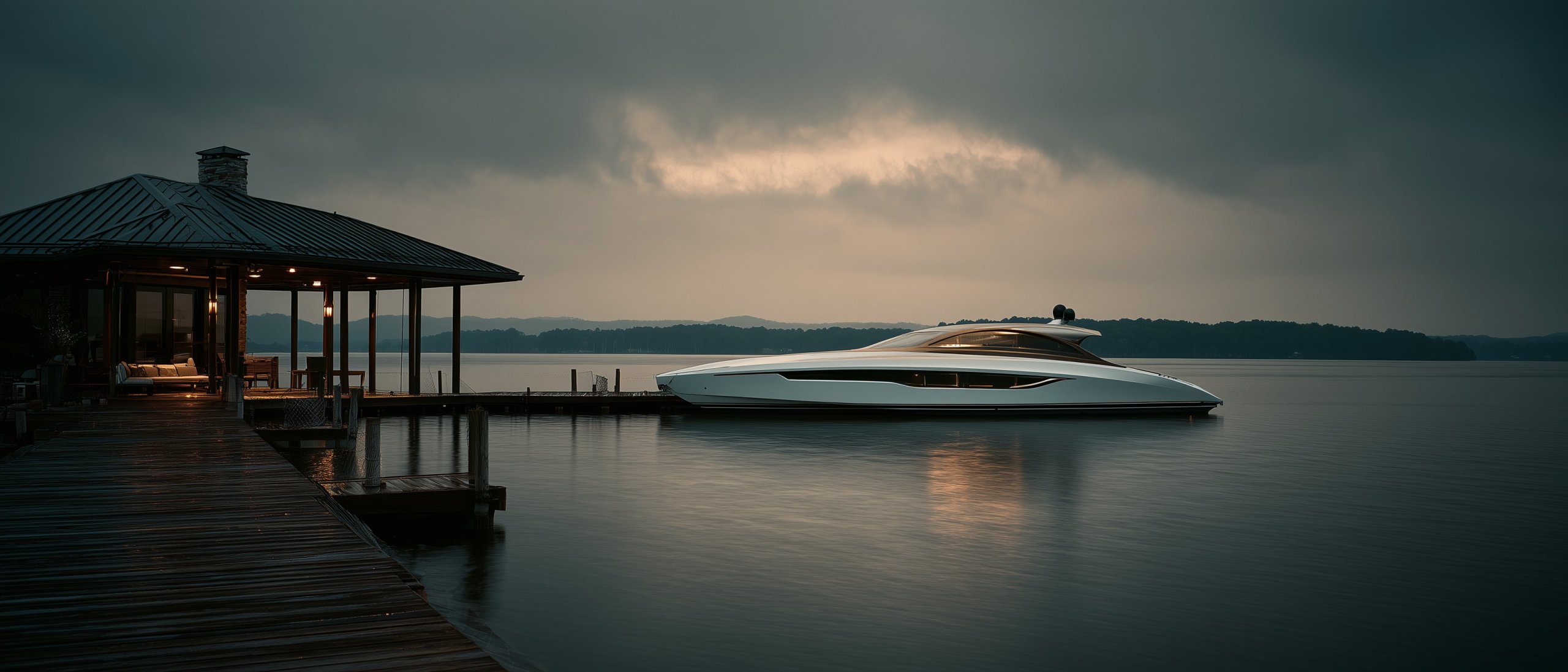
Among the three mobile platforms, the yacht is the most sovereign-estate-like in operational character. The family aboard the yacht is aboard for weeks or months rather than hours or days. The vessel operates its own power generation, its own water economy, its own connectivity, its own security architecture, its own data sovereignty discipline. The substrate scale matches the residential estate rather than approaching it. For the family whose use pattern supports extended cruising, the yacht functions as the floating instance of the sovereign estate.
The aircraft and the autonomous vehicle do not match this. The aircraft is occupied for hours rather than weeks. The vehicle is occupied for the duration of a trip rather than as a residence. Both extend the envelope and both warrant substantive engineering, but neither operates as the floating estate the yacht operates as. The yacht is the canonical apex form because it carries the most complete substrate — the most residential of the mobile platforms.
What is engineered, what is selected
Across the three platforms, the architectural commitment varies in kind. The yacht is engineered — commissioned, built, and configured to the family’s specifications, with the substrate decisions made during specification and the operational character determined during construction. The relationship with the yard (Lurssen, Feadship, Oceanco, Heesen at the apex; the broader yard ecosystem below) is a multi-year design and build relationship producing a vessel that operates for decades.
The aircraft is largely selected. The platform exists as a manufactured airframe (Gulfstream, Bombardier, Dassault at the long-range apex) and the family configures the interior and the operating-envelope integrations within that platform. The cycle is shorter than yacht commissioning, and the substrate decisions are made within the constraints of an existing aircraft type rather than from a clean specification.
The autonomous vehicle is increasingly purchased rather than commissioned, with premium configuration available but the platform fundamentally manufactured rather than built-to-spec. The replacement cycle is short and the substrate decisions are more determined by the manufacturer than by the family.
The implication is that the family’s substrate decisions have the longest reach with the yacht, intermediate reach with the aircraft, and shortest reach with the vehicle. The engineering attention across the three platforms scales accordingly.
The platform is what carries the envelope across the boundary. The substrate is what makes the envelope continuous when it crosses.
The Kit
The Kit is the personal layer the principal carries continuously — the wearables, the secure devices, the encrypted communications setup the family operates regardless of which platform they are aboard. The Kit is treated under Intelligence as its own child rather than as a section here.
The reasoning is structural. The Kit operates equally at the residence, aboard the yacht, on the aircraft, in the vehicle, at a sovereign-grade resort, and at every other location the family occupies. It is not part of the operating envelope’s extension beyond the property line because it is also part of the envelope at the property line. The principal wearing the Apple Watch and carrying the secure laptop at home is operating Kit; the same Kit operates everywhere else. Architecturally, it is the always-on layer of the cognitive substrate at personal scale, which makes it Intelligence-pillar work rather than Destination-pillar work.
How the mobile estate fits within Destination
The Destination pillar treats four extensions of the sovereign envelope. The mobile estate (this page) is the platforms the family owns and operates in motion. The multi-property estate is the additional fixed properties the family owns. Sovereign-grade resorts and villas is the commercial-residential properties the family stays at as guest or vetted member. Sovereign memberships is the access architecture — clubs, FBOs, marinas — through which the family operates the broader vetted-membership world.
The mobile estate sits alongside the multi-property estate as the second of the two owned-and-controlled categories. Where the multi-property estate is the fixed instances of the sovereign envelope, the mobile estate is the moving instances. The two together comprise the universe of properties and platforms over which the principal has direct engineering control. The other two Destination children describe the world the principal moves through but does not own.
The mobile estate is the engineering commitment that the sovereign envelope is continuous across the family’s movements. The yacht carries the envelope at sea. The aircraft carries it through the air. The autonomous vehicle carries it across the road. The platform is what bridges the boundary; the substrate is what makes the bridge complete. Without the mobile estate, the envelope ends at the property line.