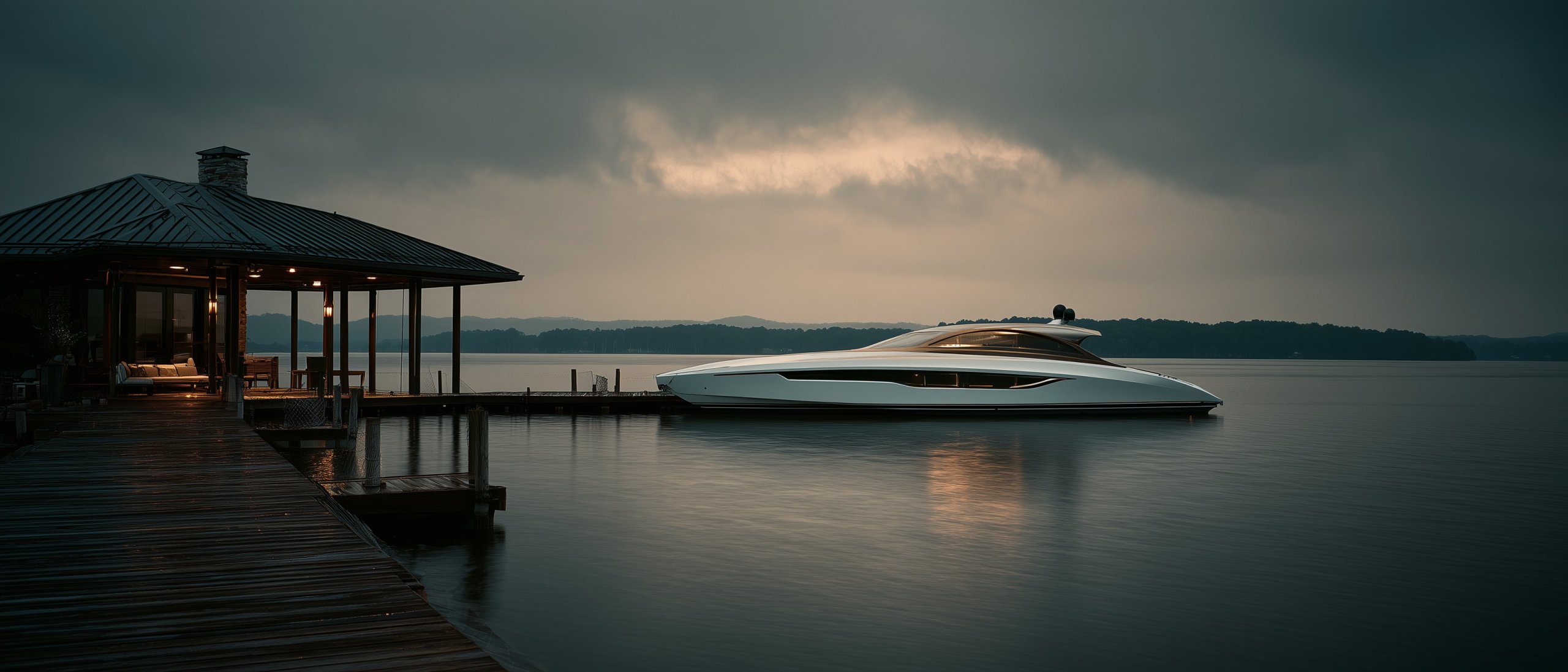
The mobile estate comprises three platforms the family owns and operates while in motion. The yacht is the first of those platforms and the one that most fully extends the substrate disciplines the residence operates by. The aircraft is a transit platform occupied for hours. The autonomous vehicle is a ground platform occupied for the duration of a trip. The yacht is a residence at sea, occupied for the same kinds of durations the family occupies its residences ashore — and engineered accordingly.
The scale at which this resolution holds is roughly the 50-meter motor yacht and above, with the expedition-yacht category producing variants of similar substance at comparable scale. Below that threshold, the substrate compresses: smaller batteries, smaller water capacity, smaller compute footprint, smaller crew, less complete operational autonomy. A 30-meter family cruising yacht is a serious platform, but it is not a floating estate in the sense this page treats. The 60-meter, 80-meter, and larger motor yacht is.
The yards
The substantial motor yacht at sovereign-estate scale is built by a small number of yards with the engineering depth, the supply chain, and the multi-year project capability the work requires. At the apex, Lürssen and Feadship dominate the largest custom builds, with Oceanco and Heesen producing comparable vessels at slightly smaller scale. Damen Yachting, the parent of the Amels series and the Xplorer expedition range, builds at substantial scale across categories. Benetti and Sanlorenzo operate at substantial volume below the apex with capable vessels at competitive economics. Turkish yards — Bilgin, Sunrise, and the broader regional ecosystem — have produced increasingly capable vessels at progressively higher engineering standards over the last decade.
The relationship is multi-year and structural. A yacht commissioned this year arrives three to five years later, with the substrate decisions made during specification and the operational character determined during construction. The family-yard relationship is closer to the building-architect relationship than to the consumer-purchase relationship: the family is commissioning a substantial engineered asset, not selecting from a catalog. The decisions made at the specification stage shape what the vessel actually is for the next several decades of operation.
Power and propulsion
The contemporary substantial yacht operates as a power generation and management platform in its own right. The architecture has shifted in the last decade from direct-drive diesel to diesel-electric, and increasingly to hybrid diesel-electric with substantial battery banks.
In a diesel-electric architecture, multiple diesel gensets produce electrical power that drives electric propulsion motors. Engine speed decouples from propeller speed. Redundancy improves: the vessel can lose one genset without losing propulsion. Hybrid extends this with substantial battery banks — at the apex, often a megawatt-hour or more of capacity — that support silent operation at anchor, peak-shaving against generator load, and zero-emission cruising at low speeds in protected waters or regulated zones. Photovoltaic generation contributes where deck area permits.
Feadship’s Savannah, delivered in 2015, was the first hybrid superyacht. A decade later, the architecture is the apex standard rather than the exception. Feadship’s Breakthrough, delivered in 2025, extends the trajectory into hydrogen: the first superyacht to combine hybrid diesel-electric propulsion with a hydrogen fuel-cell system that handles hotel loads at anchor without combustion. Full battery-electric remains constrained at this scale by current battery energy density, but the hybrid configuration is the contemporary baseline, and the trajectory is toward greater electrical autonomy as the underlying technology matures.
Water and supply
The yacht of substantial scale operates its own water economy through reverse-osmosis desalination, substantial freshwater storage, and the gray-water and black-water management the vessel’s operation requires. The desalination plant is sized to the vessel’s consumption pattern, with redundancy because the vessel cannot operate at extended range without water production. Gray-water reuse increasingly extends the water autonomy in line with the broader sustainability disciplines the contemporary build engages with.
Supply-chain autonomy extends beyond water. The vessel carries fuel for thousands of nautical miles, food and consumables for weeks at sea, spare parts for the engineering and operational systems, and the tools and materials that support extended operation away from shore-side service. The substrate is not autonomous in the way the off-grid lodge is autonomous — the vessel still calls at ports for resupply — but it operates with substantial reserve at any given moment, in the same architectural posture the residential sovereign estate engages with the macro grid.
Connectivity at sea
The maritime connectivity environment has transformed in the last several years. The conventional VSAT services (Inmarsat, KVH, Iridium at the established maritime end) operated at limited bandwidth, high cost, and high latency. Starlink Maritime, launched in 2022, reframed the market: multi-LEO architecture, electronically-steered antennas, bandwidth and latency comparable to terrestrial broadband, costs an order of magnitude below what the conventional VSAT category charged for inferior service. The category matured rapidly; by mid-2025 the Starlink Maritime V4 high-performance panel had become the contemporary standard, with gigabit readiness on the constellation roadmap.
The contemporary yacht typically integrates Starlink as the primary high-bandwidth path with a secondary LEO service (OneWeb is the credible alternative, particularly for regions Starlink’s regulatory coverage does not reach — Turkey notably) and cellular where coastal coverage supports it. The architecture parallels the multi-path posture treated under Connectivity at the residence: multiple independent paths, no single provider as a backbone, full operational continuity when any single path is unavailable.
What the contemporary maritime connectivity supports is the substrate’s continuity across the boundary the property line would otherwise define. The encrypted tunnel back to the residence’s compute operates over whichever path is available. The cognitive layer, the operations console, the secure communications, and the broader cognitive-substrate integration treated under Intelligence operate aboard the vessel as they do at the residence. The household’s data sovereignty discipline extends: the yacht maintains its own local compute, the family’s data persists on vessel infrastructure under the family’s control, the household’s reasoning operates on equipment the family owns rather than streaming through vendor cloud services.
The yacht is a residence at sea, occupied for the same kinds of durations the family occupies its residences ashore — and engineered accordingly. The substrate scales to the residential, not toward it.
Security and counter-surveillance
Security at sea operates against a different threat model than security at the residence. The vessel is a high-visibility, high-value asset, often in foreign waters, with limited recourse to law enforcement in the event of an incident. The yacht’s security architecture addresses the categories of threat the operational reality produces, with rigor that matches the residential posture rather than relaxing from it.
The physical security architecture covers what conventional vessel security covers — camera coverage of all decks, intruder detection on the perimeter, secure-cabin retreat capability for the family, the broader vessel-security integration — at standards matched to the residential discipline. The counter-surveillance posture addresses the categories of threat that observation produces on a high-visibility platform: photographic and video surveillance from adjacent vessels and from shore, radio-frequency surveillance directed at the vessel’s communications, and the broader monitoring high-profile platforms attract. Cybersecurity covers the vessel’s integrated bridge, engineering, AV, and IT systems as the substrate they are, with the same architectural rigor the residential Security & surveillance discipline brings.
Where the family commits to it, dedicated security personnel aboard during cruising add a layer the conventional yacht does not run. The discipline is consistent with the residential threat model. The vessel does not relax security because it is in vacation mode, because the vessel is not in vacation mode.
The crew
The substantial yacht operates with a professional crew whose discipline is the closest analog among the mobile platforms to the residential staff structure. The captain commands the vessel and is responsible for safety, operations, and the vessel’s continued capability. The chief engineer manages propulsion, electrical, mechanical, and the broader engineering substrate. The chief officer handles deck operations and the integration with the security architecture. The chief stewardess oversees the interior and guest service. The chef, the deckhands, the stewards, the junior engineers, and the broader crew execute the operational program. Crew sizes scale with vessel scale: roughly eight to twelve aboard a 50-meter yacht, fifteen to twenty-five aboard a 70-to-80-meter yacht, thirty or more aboard the largest builds.
What distinguishes a sovereign-grade yacht crew from a conventional luxury-yacht crew is operational, not technical. The crew operates as the working extension of the household’s broader operational discipline — vetted to the standards the residential staff is vetted to, trained in the security and privacy protocols the household operates by, integrated with the family-office and the residential EstateOps function. Engineering produces the platform’s capability; the crew is what produces the platform’s operational character.
The expedition category
One yacht category warrants separate treatment because it aligns most closely with the broader sovereign-estate proposition: the expedition yacht, designed for extended cruising in remote and high-latitude waters rather than for Mediterranean-and-Caribbean port-and-anchor operation.
Damen Yachting’s Xplorer range (formerly SeaXplorer) is the canonical platform: 60-meter, 80-meter, and 105-meter Xplorer vessels with ice-class hulls, IMO Polar Code compliance, thirty-to-forty-day autonomy at sea, certified helidecks and hangars, and hybrid propulsion as standard. The 60-meter After You, delivered in 2025, was the first Xplorer 60 to leave the yard, with a second Xplorer 60 in build and the larger platforms in build and concept. Lürssen’s expedition builds and the broader yard ecosystem produce comparable vessels at fully custom commissioning.
The expedition yacht aligns particularly well with the sovereign-estate framing because the engineering the platform requires — substantial autonomy, extended operation without resupply, capability in environments where shore-side support is absent — is the maritime expression of the architectural disciplines the residential estate engages with. The microgrid is not optional. The water economy is not optional. The connectivity is not redundant. The category exists because the operational reality demands it, and the engineering rigor follows.
How the yacht fits within the mobile estate
The yacht is the first child of the mobile estate and the canonical apex form. Estate aviation is the second — the aircraft platforms and FBO ecosystem that extend the operating envelope by altitude. The autonomous vehicle is the third — the ground platform with the most continuous occupation by hours but the smallest substrate scale.
The three are not interchangeable. The yacht is a residence at sea; the aircraft is a transit platform; the vehicle is a mobile working space. Each warrants its own substantive engineering and each extends the operating envelope in different dimensions. What they share is principal control: the family owns and engineers each of them, with the substrate decisions made during acquisition or commissioning rather than discovered during operation.
The yacht as floating estate is the engineering proposition that the substrate disciplines the residence operates by extend onto a platform that moves. The power generation, the water economy, the connectivity, the security posture, the data sovereignty, and the operational crew are all engineered to residential standards on the vessel itself. The family aboard the yacht is aboard their sovereign estate, with the boundary the property line would otherwise define crossed by the vessel rather than by the family. That crossing is what the engineering is for.