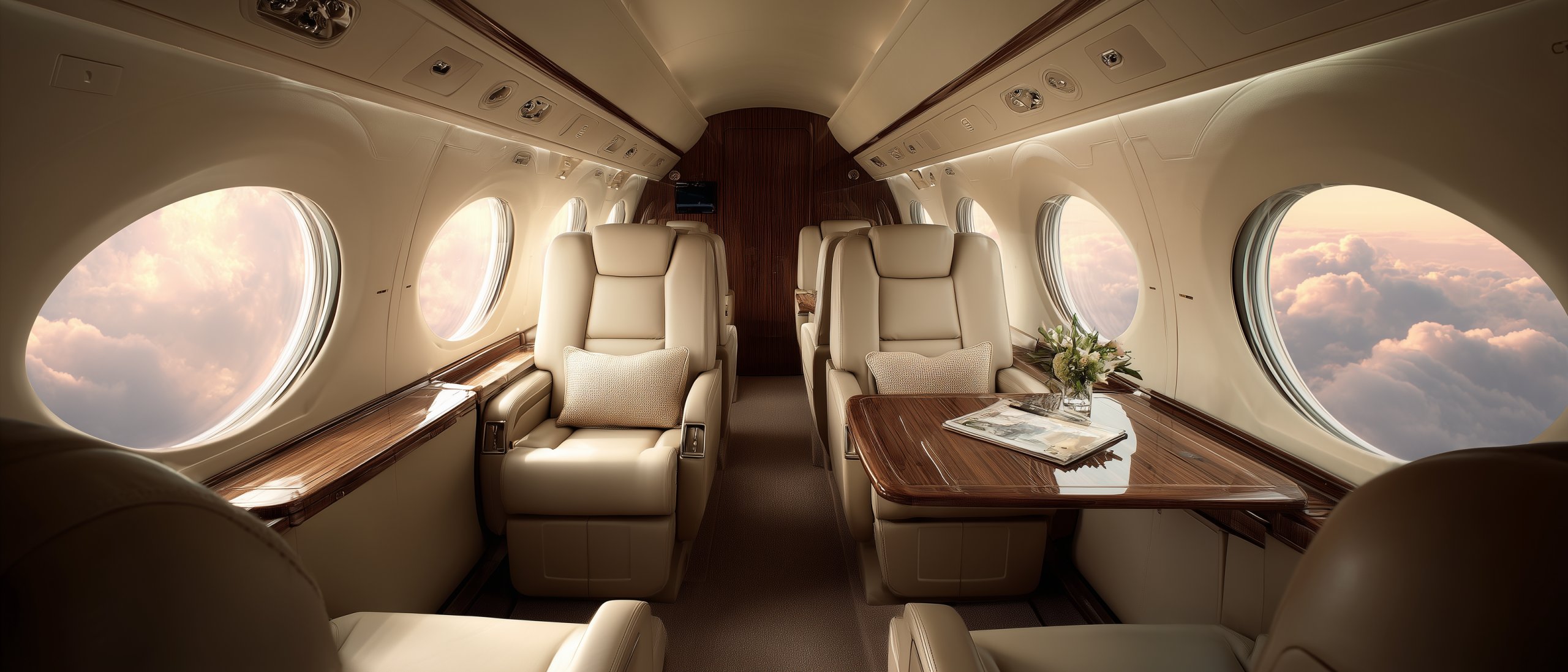
The yacht is a residence at sea, occupied for weeks or months, with the substrate scaling to residential. The aircraft is structurally different. Flight duration is measured in hours. The aircraft’s substrate — power, environmental, connectivity, security — operates at platform scale rather than at residential scale, because the platform does not exist long enough at any one altitude to need residential scale. The envelope extension is shorter in time but covers more distance.
What aviation distinctively adds in compensation is the ground-side ecosystem the operation runs through. The FBO at the departure field. The handler at the destination. The customs and immigration arrangements at international transits. The vehicle-to-aircraft and aircraft-to-vehicle handoffs that bookend the flight. The aviation envelope is half airborne and half on the ground, and the ground side is where the threat surface is largest and where the engineering matters most. Treating aviation as flying misses where most of the operational discipline actually lives.
The aircraft itself is largely selected rather than commissioned. The platform exists as a manufactured airframe — Gulfstream, Bombardier, Dassault at the long-range apex — and the family configures the interior and the operating-envelope integrations within the constraints of that platform. The substrate decisions the family makes at the yacht specification stage have decade-long reach into how the vessel actually operates; the decisions at aircraft acquisition have shorter reach because the airframe itself is fixed. The engineering attention shifts from the platform to the operational layer that wraps around it.
The aircraft categories
Aviation at sovereign-estate scale spans three working categories of aircraft, with a fourth emerging.
Long-range and ultra-long-range jets. The intercontinental platform. Gulfstream’s G700, in service since 2022, and the G800, delivered to its first customer in August 2025 following FAA and EASA certification in April — replacing the long-serving G650 with 8,200-nautical-mile range as the longest-range business aircraft in production. Bombardier’s Global 7500, in service since 2018, and the Global 8000 as the higher-range extension. Dassault’s Falcon 10X as the long-range twin-engine flagship in development. These are the platforms for the family operating across continents nonstop — North America to Asia direct, Europe to South America direct — patterns that sub-long-range jets cannot fly without a refueling stop.
Mid-size and super-mid jets. The regional and continental platform. Gulfstream’s G280 and G400. Bombardier’s Challenger 350/3500 and 650. Cessna’s Citation Longitude and Latitude. Embraer’s Praetor 500 and 600. These platforms handle the regional patterns where the long-range aircraft is the wrong tool — the runway constraints, the fuel-burn economics, the occupancy patterns — and they constitute the majority of contemporary business-aviation movements.
Helicopters. The short-range platform for families with the property-helipad infrastructure to use it. Airbus’s H145, H160, and H175. Sikorsky’s S-76 and S-92. Bell’s 525 and 429. The mission is different from the jet: the flight from the property to the regional airfield for departure on the long-range platform, the flight from the yacht to a shore destination, the inter-property flight within helicopter range, the broader category of short-range aviation the family operates regularly.
eVTOL (emerging). The electric vertical-takeoff-and-landing category at the certification frontier. Joby Aviation reached Stage 4 of FAA type certification in November 2025 — the first eVTOL to do so — with initial commercial operations approaching in Dubai. Archer Aviation remains in Stage 3 with its Midnight aircraft. Beta Technologies and Wisk Aero are pursuing separate certification paths. The category has had failures: Lilium declared insolvency in November 2024. The timeline for genuine integration into private aviation extends through the late 2020s, but the architectural commitment available today is to design helipad and electrical infrastructure that can accommodate eVTOL platforms as they certify and enter service.
In-flight connectivity
The in-flight connectivity environment has transformed in the last two years. The conventional in-flight systems — Gogo Avance, Viasat Ka-band, Honeywell JetWave — operated at limited bandwidth that constrained the principal’s ability to work productively at altitude. Starlink Aviation, launched commercially in 2023, reframed the market: the multi-LEO architecture, bandwidth and latency comparable to terrestrial broadband, costs an order of magnitude below what the legacy in-flight providers charged for inferior service.
The category matured rapidly. By late 2025 more than thirty supplemental type certificates had been approved across business jet models from Gulfstream, Bombardier, Dassault, Embraer, and Textron Aviation. Gulfstream’s hundredth Starlink-equipped aircraft delivered in September 2025. NetJets committed to a fleet-wide rollout across roughly six hundred aircraft, covering the Bombardier Global fleet, Challenger 350s and 650s, Citation Latitudes and Longitudes, and Praetor 500s. The technology has gone from category curiosity to industry standard inside three years.
The integration with the residential estate’s connectivity architecture operates as it does at sea: the encrypted tunnel back to the residence’s compute, the cognitive layer accessible during flight, the operational console available to the principal. The aircraft is in flight for hours rather than weeks, but those hours are productive working time when the connectivity supports it — and the family-office that values the time aboard the aircraft as working hours, not as transit gaps, invests in the connectivity infrastructure that makes the time productive.
Aviation is half airborne and half on the ground. The aircraft is the platform, but it is not the totality.
The FBO ecosystem
The fixed-base operator is the ground-side infrastructure that operates around private aviation. The FBO at Teterboro serving New York. The FBO at Le Bourget serving Paris. The FBOs at Nice and Cannes serving the Mediterranean coast. The FBO at Van Nuys serving Los Angeles. The FBO at Farnborough serving London. The equivalent infrastructure at substantial airfields globally. These are the ground-side platforms the family’s aviation operates through.
The established networks — Signature Aviation, Jet Aviation, Universal Aviation, Million Air, Atlantic Aviation, and the broader category — provide consistent operational standards across the airfields they serve. For families whose aviation pattern is concentrated at specific airfields, the relationship with the FBO operator at those fields becomes part of the operational discipline. The FBO with reliable ground service, modern facilities, efficient customs processing, and security posture matched to the family’s threat model operates differently than the FBO that defaults to commercial-aviation standards.
The deeper treatment of FBO networks as membership-and-relationship architecture lives on Sovereign memberships; what matters here is that the family’s aviation envelope operates only as well as the ground-side infrastructure supports it. The engineering on the aircraft side cannot compensate for ground-side gaps. The two halves of the envelope are co-equal.
Transit security
The vehicle-to-aircraft and aircraft-to-vehicle handoffs are where the aviation envelope is most exposed. The vehicle pulls up to the FBO. The principal walks across the apron. The aircraft is staged for departure. The customs and immigration officers, where present, process the documentation. The reverse pattern on arrival. Inside the vehicle, the perimeter is engineered. Inside the aircraft, the perimeter is the aircraft itself. At the handoff, the perimeter is the FBO’s discipline.
The transit-security architecture addresses this. The FBO with secured ramp access, controlled staging areas, customs and immigration handling that does not require the principal to transit public terminal infrastructure, and the broader operational discipline that treats the principal as a substantive client rather than as one of many transit passengers — this is the FBO the substantial-aviation family selects. The discipline at the family-office level is engaging the FBO relationship as operational infrastructure rather than as service convenience.
The helicopter for daily extension
For families with the property-helipad infrastructure to operate from, the helicopter is the daily-aviation extension of the residential envelope. The flight from the property to the regional airfield for departure on the long-range aircraft. The flight from the yacht to a shore destination. The flight between properties within helicopter range. The broader category of short-range aviation the family operates regularly without engaging the long-range fleet.
The helicopter as operating-envelope platform extends the envelope similarly to the autonomous vehicle but with the air-domain freedom that ground transportation does not provide. The connectivity, the security envelope, and the integration with the family’s broader operational architecture operate during helicopter flight as they do during longer aviation operations. The eVTOL category, when it certifies into service, extends this logic with lower noise, lower operating cost, and the lower environmental impact electric propulsion produces — for the same short-range missions the helicopter currently flies.
How aviation fits within the mobile estate
Aviation is the second child of the mobile estate, alongside The yacht as the canonical apex form and The autonomous vehicle as the most continuously occupied ground platform. The three are not interchangeable. The yacht is a residence at sea. The aircraft is a transit platform with substantial ground-side infrastructure. The vehicle is a mobile working space operated continuously.
What aviation distinctively brings is reach. The yacht moves at fifteen knots. The autonomous vehicle moves at highway speeds. The aircraft crosses oceans in hours. The family operating across multiple continents, multiple time zones, and multiple properties globally cannot do so without aviation, and the aviation envelope is what makes the geographic reach feel continuous rather than discontinuous. The substrate disciplines that operate at the residence operate during the flight, between the flight legs, at the FBOs, and across the handoffs that bridge the family’s movements.
Aviation extends the sovereign envelope by altitude, with the engineering distributed differently than it is on the yacht or the vehicle. The aircraft is the platform but not the totality. The FBO ecosystem, the in-flight connectivity, the transit-security discipline, and the integration with the family’s broader operational architecture are what make the aviation envelope sovereign-grade. The aircraft that flies the principal across the Atlantic without the ground-side discipline that wraps around it is an aircraft, not an envelope extension.