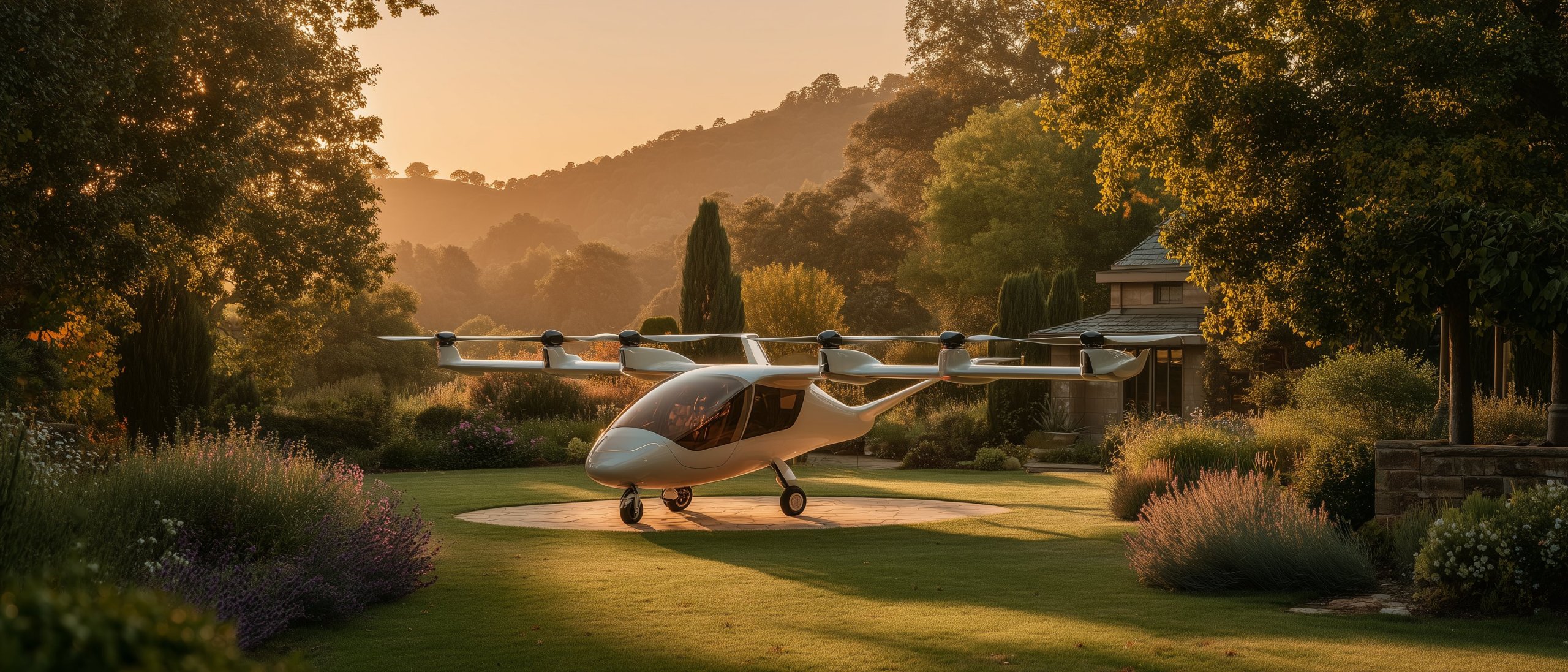
eVTOL is the emerging category the industry has committed to. The helicopter is what operates today. For an estate making aviation infrastructure decisions now, the helicopter is the working platform — what arrives at the pad in the morning, what carries the principal to the regional airfield, what serves the family’s actual current operational pattern. The transition treated on the Aviation pillar is real, but the transition operates across a decade and beyond, and the helicopter remains the right operational answer for most of what families fly today.
What keeps the helicopter dominant for the conditions eVTOL cannot yet match is engineering. Range: several hundred nautical miles, against one hundred to one hundred fifty for current eVTOL. All-weather and instrument-flight-rules capability: the certified helicopter operates in conditions the current eVTOL generation does not. Payload: the intermediate-twin helicopter carries eight to twelve passengers plus crew, well above the four-to-five-passenger eVTOL standard. Heavy-lift capability: the helicopter handles cargo, equipment, and rescue operations no eVTOL platform serves. These are not marginal advantages; they are structural ones that will shift only as the eVTOL category matures across the rest of the decade and beyond.
This page treats the helicopter platforms operating at sovereign-estate scale, the categories within the rotary class, the operational characteristics that distinguish executive helicopters from general-aviation rotorcraft, and the electric trajectory now under development that will eventually produce the all-electric direct-drive helicopter as a credible alternative to the turbine workhorse.
The platform categories
Helicopters at sovereign-estate scale sort into three working categories by size and mission.
Light twin. The smaller end of executive rotary, with the redundancy of two engines that single-engine platforms cannot match. Airbus H145 as the most widely deployed example, a five-bladed light twin with substantial cabin volume and the operational versatility that makes it the workhorse of much of European executive rotary. Bell 429 as the American counterpart, a four-bladed twin with comparable performance and a well-established maintenance ecosystem. Both platforms operate at the high end of the light-twin category and serve as the entry point into serious executive rotary for many families.
Intermediate twin. The substantial executive helicopters that dominate estate aviation at the apex. Airbus H160 as the newer entrant, a clean-sheet five-bladed design that entered service in 2020 with substantial noise reduction and improved operating economics over its H155 predecessor. Leonardo AW139 as the dominant intermediate twin worldwide, with more than a thousand vehicles in service across executive, offshore, EMS, and government roles. Leonardo AW169 as the smaller of the Leonardo intermediate twins, increasingly common at the upper end of private executive operation. Sikorsky S-76D as the long-serving American executive platform, in production for decades with continuous evolution.
Heavy. The largest rotorcraft at the executive end, used by families whose operations require the cabin volume, range, or payload smaller platforms cannot serve. Airbus H175 as the substantial European heavy. Sikorsky S-92 as the offshore-and-government workhorse occasionally configured for the most demanding executive applications. The heavy category is less common at residential estate scale and more common at family-office operations supporting multiple residences and a broader operational pattern.
The helicopter is not legacy infrastructure being replaced. It is the working platform that current operational reality requires, with the successor category in development behind it.
The operational characteristics
Several operational characteristics distinguish the executive helicopter from general-aviation rotary and from the eVTOL alternative.
Range. The intermediate-twin executive helicopter typically operates with four hundred to five hundred nautical mile range, with longer-range configurations available for specific platforms. This is the range that supports same-day round-trip operations between an estate and a regional center several hundred miles away — the operational pattern that defines executive helicopter use.
All-weather capability. Executive helicopters certified for instrument-flight-rules operation operate in conditions general-aviation aircraft cannot, with substantial avionics, dual pilots in many configurations, and the operational discipline that supports flight in marginal visibility and weather. The certified IFR helicopter is what supports estate aviation as a year-round operational capability rather than a fair-weather convenience.
Payload. The intermediate-twin carries eight to twelve passengers in executive configuration, with the cabin volume to support working space, baggage, and the operational equipment substantial travel patterns require. This is multiples beyond what current eVTOL platforms serve.
Operational rhythm. The helicopter is refueled in minutes from fuel storage or a fuel truck. The maintenance cycle is established and supported by a mature global ecosystem of manufacturer-authorized service centers, parts supply, and crew training. The platform is well-known to the integrators and operators the family engages.
Operating cost. The turbine helicopter operates at substantial cost per flight hour — fuel, maintenance, crew, hangar, insurance. The cost structure is well-established and predictable, with no novel variables that emerging categories carry. For the family operating substantial rotary hours, the cost is real; what the family acquires is operational capability that does not arrive any other way today.
The electric trajectory
The all-electric direct-drive helicopter is under development, with a clear technical path that does not require the distributed-propulsion architecture eVTOL platforms use. The leading program is the Robinson/magniX eR66, announced in July 2025 — an electric conversion of the widely deployed five-seat Robinson R66, with magniX providing the integrated electric powertrain (the HeliStorm electric motor and Samson battery system) and Robinson providing the certified airframe.
The eR66 demonstrator is targeted for first flight in late 2026, with type certification and production aircraft following on a multi-year timeline. The range is constrained by current battery energy density: approximately one hundred eighty-five kilometers, against six hundred fifty kilometers for the gas-turbine R66. The trade-off is significant operating-cost reduction, substantial noise reduction, and the elimination of turbine emissions for the missions the range supports. The platform is targeted initially at tourism, training, and short-mission applications where the range constraint is not binding.
The architectural significance of the eR66 program for sovereign-estate aviation is that it represents an alternative trajectory from the eVTOL category — the direct-drive electric helicopter, building on a certified airframe and existing manufacturer ecosystem, achievable on a shorter timeline than clean-sheet eVTOL platforms. Whether the direct-drive electric helicopter or the distributed-propulsion eVTOL ultimately dominates the short-haul executive role is genuinely uncertain. Both will exist; the balance will shift over the next decade.
How helicopters fit within Aviation
Helicopters sit alongside eVTOL and Seaplanes as the three sub-categories of aircraft that operate from the sovereign estate. Across the three, the helicopter is the dominant operational platform today, with eVTOL emerging as the structural successor and seaplanes serving the waterfront and lake-access estates where water-takeoff is essential.
What this means for the family planning estate aviation now is that the helicopter is the platform the family will operate for the foreseeable future, with the eVTOL pad provisioning treated under Aviation as the architectural commitment that accommodates the transition when it arrives. The helicopter is not legacy infrastructure being replaced; it is the working platform that current operational reality requires, with the successor category in development behind it.
The helicopter is the workhorse of estate aviation. The platforms are mature, the operational ecosystem is established, the engineering tradeoffs are well-understood, and the operational capability matches what sovereign-estate aviation actually requires today. The transition to eVTOL is real but operates across years rather than seasons; the helicopter is what the family flies in the meantime, and for the conditions eVTOL will not match for years to come, the helicopter remains the right operational answer regardless of how the transition unfolds.