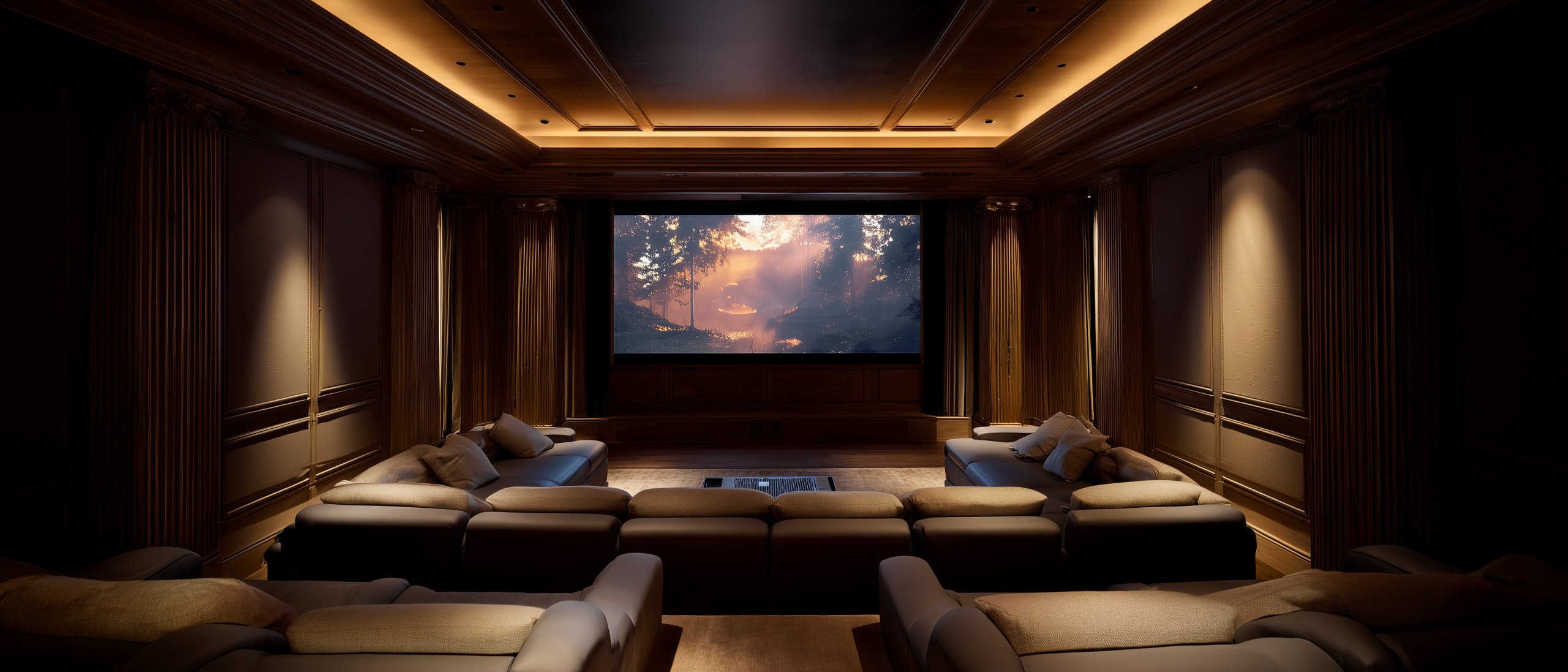
The AV system at sovereign-estate scale is genuinely substantial — multi-room audio reaching every space the family occupies, dedicated home theater built to performance standards that match what commercial cinema delivers, video displays integrated into common areas, working spaces, and bedrooms, and the broader infrastructure that supports the family’s content consumption across all of it. The system is one of the most architecturally invasive of the Automation subsystems because the cable runs, the equipment locations, the speaker placements, and the display integrations all happen during construction and are difficult to revise afterward.
The architectural shift in AV over the last several years has been the displacement of the HDMI matrix by AV-over-IP. The HDMI matrix architecture routed video signals through dedicated matrix switchers connected by HDMI cables — a topology that worked at modest scale but produced substantial limitations at substantial scale (matrix size constraints, cable distance limits, the rigidity of point-to-point cabling). AV-over-IP routes the same signals over a standard IP network using protocols like Crestron NVX, AMX SVSi, and Q-SYS NV-Series — eliminating the matrix as a single point of failure and limitation, supporting effectively unlimited endpoints, and converging AV with the rest of the household’s network infrastructure. For sovereign-estate-scale work the shift is essentially complete; new builds specify AV-over-IP rather than HDMI matrices.
What follows treats the four major sub-categories of AV — multi-room audio, home theater, the broader display architecture, and outdoor AV — and the major architectural decisions that shape what the system actually is.
Multi-room audio
Multi-room audio is the layer that produces music throughout the residence. The architectural commitment is in-ceiling and in-wall speakers throughout the spaces the family occupies, with the speaker placement, the amplifier and source architecture, and the control protocols engineered during design.
The high end of the category divides between three approaches. The integrated-platform approach (Crestron Audio, Savant Music) treats audio as a sub-component of the broader automation system, with the audio infrastructure deeply integrated into the touch panels, scenes, and broader operational architecture. The dedicated-audio approach (McIntosh, Linn, Naim) treats audio as a discipline with its own engineering depth, with high-end amplifiers and source components selected for audio performance rather than for integration depth. The networked-audio approach (Sonos at the upper end, Sonance with broader integrator support) treats audio as a networked service, with addressable speakers and the streaming-service integration as primary architectural concerns.
At sovereign-estate scale the typical configuration combines elements. The family-area audio operates against the integrated platform (one touch panel controls audio alongside lighting, climate, and AV); the dedicated listening room operates against high-end audio components selected by the family for performance; the broader background-music infrastructure operates against the networked-audio backbone with the streaming-service integration the household uses. The integrator coordinates these.
The speaker selection is the most architecturally visible decision. Sonance, James Loudspeaker, Episode, and Triad dominate the architectural-speaker category (in-ceiling and in-wall designs engineered for the residential application). Bowers & Wilkins, Wilson Audio, Magico, and the broader high-end audio specialists serve the dedicated listening room and the home theater where the architectural-speaker performance is insufficient.
The HDMI matrix is yesterday’s topology. AV-over-IP is the architectural commitment that supports decades of component evolution without rewiring.
Home theater
The home theater is a dedicated space engineered for performance — the room acoustics, the seating layout, the screen and projection or LED wall, the speaker arrangement engineered against the listening positions, and the climate control that supports long viewing sessions without compromise. At sovereign-estate scale the home theater is a substantial architectural commitment, with the room sized and detailed for the engineering before the architectural design freezes.
The major architectural decision is screen technology. Three options dominate. Front projection (Sony, Barco, Christie, Digital Projection at the high end) projects onto a substantial screen, with the throw distance and the room dimensions engineered together. The advantages are scale (screens of 150 inches and substantially larger) and the cinematic feel that front projection produces. The disadvantages are the ambient-light sensitivity, the projector maintenance, and the architectural commitment to the projector booth or ceiling mount that the topology requires.
Direct-view LED video wall (Samsung Wall, LG Magnit, Sony Crystal LED) produces a screen image without projection, with substantially higher brightness, better contrast in ambient light, and the form-factor flexibility that LED panels offer. The technology was prohibitively expensive a decade ago and has come down substantially, with the upper-end installations now competitive with high-end projection at moderate sizes (100-200 inches).
OLED and MicroLED at the consumer scale (LG, Samsung, Sony) handle the smaller display applications in the home theater (auxiliary displays, processor monitors) and increasingly compete with LED wall for the primary display at modest screen sizes.
The audio architecture for the home theater is the substantial commitment — typically a 7.1.4 or 9.2.6 immersive-audio configuration with the speakers calibrated against the room acoustics and the listening positions. Steinway Lyngdorf, JBL Synthesis, Wisdom Audio, and the broader category of dedicated-cinema audio specialists serve the home theater at sovereign-estate scale.
The broader display architecture
Beyond the dedicated home theater, displays appear throughout the residence — the working spaces, the bedrooms, the kitchen, the outdoor spaces where the family gathers. The architectural decisions shape what is installed where.
OLED displays (LG, Sony, Samsung) dominate the residential display category at sizes from 55 to 97 inches, with the picture quality and form-factor flexibility that the technology has produced. The technology is essentially solved at this scale and the engineering decisions are about content sources, mounting, and integration rather than about which technology to specify.
Larger displays — outdoor areas, substantial common spaces — increasingly use LED video wall technology, with the brightness and the ambient-light tolerance that conventional displays do not provide. The outdoor display engineering is genuinely substantial; the displays must operate against the climate envelope (rain, sun, temperature) the outdoor space exposes them to.
The integration with the broader AV substrate operates through the AV-over-IP backbone treated above. The display in any room can show content from any source the household has provisioned, with the source-to-display routing managed by the integrated automation rather than by dedicated infrastructure per display.
Outdoor AV
For estates with substantial outdoor entertaining infrastructure — pool decks, outdoor kitchens, pavilions, tennis or sport courts — outdoor AV extends the household’s audio and video to these spaces. The engineering is genuinely different from indoor AV: weather-resistant speakers and displays (Sonance landscape series, James Loudspeaker outdoor, Séura outdoor displays), the cable runs and equipment locations that survive outdoor environments, and the protocol integrations that operate the outdoor spaces alongside the indoor systems.
The architectural commitment for outdoor AV is made during landscape design — the cable runs through hardscape and underground conduits, the equipment locations in weatherproof enclosures, the speaker placements that produce the coverage the outdoor space requires. Retrofit through finished landscape is substantially more disruptive than indoor retrofit.
Relationship to EstateAI
Automation executes; EstateAI reasons. The audio system routes the morning playlist to the spaces the household is occupying. The home theater preheats to the screening time the family has scheduled. The outdoor speakers activate when the family moves to the patio. The automation handles the routing, the volume, the source selection, the routine operational management; EstateAI anticipates what the family wants based on patterns rather than against schedules alone. The system is reliable without the AI; the AI makes it more useful.
How audio-visual fits within Automation
Audio-visual sits as the third of four subsystems treated under Automation — alongside Lighting & shades, Climate, and Mechanical & access. Across the four, AV is the most visible to guests and the most subject to evolution as content technology continues to develop — the displays and the source components have shorter useful lives than the building infrastructure that supports them, with the architectural decisions about cabling, equipment-room space, and integration capacity outlasting the specific components installed in them.
Audio-visual is the entertainment and media substrate that the family experiences continuously across the residence. At sovereign-estate scale the system spans multi-room audio, dedicated home theater, the broader display architecture, and outdoor AV — operating against the AV-over-IP backbone that has displaced the HDMI matrix architecture of the previous generation. The decisions made during design about the equipment-room space, the cable routing, the speaker placements, and the AV-over-IP infrastructure shape what the system is for the next several decades, with the specific components installed in them changing across that timeframe as the technology evolves.