Automation · 04

Mechanical & access

The physical actuators of the residence — irrigation, water features, pool and spa automation, gates, locks, garage doors, and the access-control infrastructure that operates alongside security. The systems that physically move, open, close, and run on schedules.

The category

Mechanical and access is the layer of Automation that produces physical motion in the residence. The lighting and AV subsystems produce light and sound; the climate subsystem produces temperature and air quality; the mechanical and access subsystem produces motion — gates that open, locks that release, pools that warm, irrigation that runs, water features that activate. The category overlaps substantially with the Security architecture treated separately, with access control operating as a shared substrate between the two.

The mechanical and access subsystem of Automation handles everything that physically moves on the residence. The irrigation that runs at scheduled times against soil-moisture data. The pool that warms before the family arrives for the evening swim. The water features that activate when guests are expected. The gates that open for recognized vehicles and close behind them. The locks that release when the principal approaches with their authorized device. The garage doors that open for the resident vehicles and the deliveries the household expects. The category is broad and integrates with multiple other substrates — landscape, security, climate — but the unifying property is that it operates physical actuators on schedule or in response to events.

What distinguishes sovereign-grade mechanical and access from the consumer-grade installations the broader smart-home market produces is reliability and integration. The consumer smart lock that fails to open when the battery dies; the consumer irrigation controller that does not communicate with the rest of the household’s systems; the consumer pool controller that requires its own app and operates against its own schedule independent of the rest of the household. At sovereign-grade scale, these subsystems integrate with the broader Automation substrate and operate against the household’s unified operations console rather than against vendor-specific apps.

What follows treats the four major sub-categories of mechanical and access — water systems (irrigation, water features, pool/spa), gates and perimeter access, locks and interior access, and garage and outbuilding access — and the broader access-control architecture that operates alongside Security.

Water systems

The water systems on the residence include irrigation, decorative water features, and the pool/spa infrastructure. Each is a specialized engineering category in its own right, with the Automation integration handling the operational layer above the underlying mechanical and chemistry.

Irrigation at sovereign-estate scale operates against weather and soil-moisture data rather than against fixed schedules. Smart controllers (Rachio, Rain Bird’s IQ Cloud, Hunter Industries’ Hydrawise) integrate with weather forecasts and soil-moisture sensors to schedule watering against actual landscape needs rather than against arbitrary clock times. The integration with the broader Automation substrate operates the controllers and reports zone status alongside the rest of the household’s operational picture.

Water features (fountains, reflecting pools, decorative pools, cascades) operate against schedules and event triggers. The Automation system activates the features during occupied hours, shuts them down when the household is asleep, and integrates the features’ pumps and lighting with the broader scene logic the residence operates against.

Pool and spa automation operates the heating, the chemistry (chlorine or salt-water systems, pH balance, sanitization), the filtration cycles, the water-feature integration, and the lighting. Pentair (IntelliCenter), Hayward (OmniLogic), and Jandy (iAquaLink) are the established platforms at the residential scale; the high-end pool/spa installations operate against more substantial control systems engineered against the specific architecture. The integration with EstateAI lets the pool warm in advance of the family’s evening use rather than maintaining heat continuously, with substantial operating-cost savings against the older always-heated default.

Gates and perimeter access

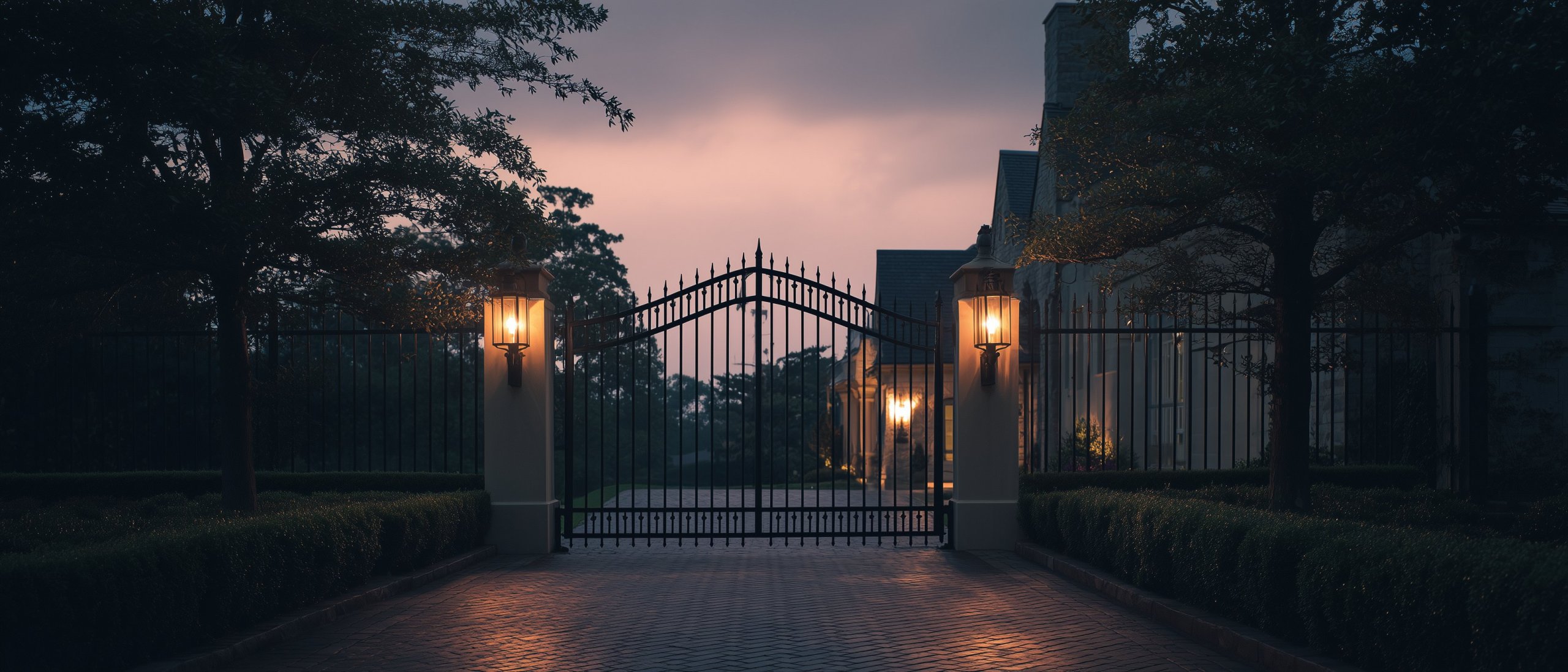
The estate’s vehicle and pedestrian gates are the physical interface between the property’s perimeter and the broader world. The gate hardware (HySecurity, FAAC, BFT, Came at the substantial-residential scale; commercial-grade hardware from the same vendors for high-security applications) operates the physical actuation; the control architecture operates the access decisions.

The access decisions at the gate divide into three categories. Recognized vehicles (the family’s vehicles, regular service vehicles) are admitted automatically against license-plate recognition or RFID transponders. Expected visitors (deliveries, guests with pre-arranged access) are admitted through the access-control system that issues time-limited credentials. Unexpected arrivals (the unknown vehicle, the unexpected visitor) are presented to the household via the intercom and admitted only against explicit operator approval.

The integration with Security is direct — the gate cameras, the license-plate recognition, the perimeter monitoring all feed into the broader security perception layer treated under Security & surveillance. The Automation layer handles the physical actuation against the access decisions; the security layer makes the decisions. The two operate together but are engineered as separate concerns.

The Automation layer handles the physical actuation against the access decisions. The security layer makes the decisions. The two operate together but are engineered as separate concerns.

Locks and interior access

Door locks throughout the residence integrate with the broader access-control architecture. The high-end residential locks (Schlage Encode at the consumer high end; Salto, ASSA ABLOY, and Allegion at the commercial-grade end) operate against credentials the household issues — the family’s authorized devices, the staff’s credentials, the time-limited credentials for service providers and guests.

The biometric layer (facial recognition, fingerprint, iris) is increasingly common at the substantial-residential scale, particularly for the family-only spaces (the principal suite, the family office, the secure storage). The biometric layer operates as supplemental rather than as primary authentication — the credential admits the family member, the biometric confirms it is genuinely them.

The interior-access architecture extends beyond the doors to safes, vault doors, gun safes, and the broader category of secured-storage access. The Automation layer integrates these with the operations console; the access events report alongside the rest of the household’s operational picture.

Garage doors and outbuilding access

The garage door and outbuilding-access architecture handles the larger physical openings the residence and outbuildings use. The garage door operators (LiftMaster, Genie, Wayne Dalton’s commercial offerings at the substantial scale) integrate with the broader Automation substrate, opening for the recognized vehicle approaching the entrance, closing automatically when the vehicle is fully in, and reporting status to the operations console.

The outbuildings (the guest house, the staff quarters, the equipment buildings, the boathouse) integrate with the same access-control architecture as the primary residence. The credentials authorized for the primary residence work at the outbuildings where the household has authorized it; the time-limited credentials work where the household issues them.

Relationship to EstateAI

Automation executes; EstateAI reasons. The irrigation runs on the schedule the controller is programmed against. The pool warms when the schedule indicates. The gate opens for the recognized vehicle. EstateAI optimizes the timing — the irrigation against the actual soil moisture and the weather forecast rather than against the static schedule; the pool against the family’s actual evening pattern rather than against the always-on default; the gate against the household’s awareness of which vehicles are expected and when. The mechanical and access infrastructure operates reliably without the cognitive layer; the cognitive layer adds the optimization that makes the operation more efficient.

How mechanical and access fits within Automation

Mechanical and access sits as the fourth of four subsystems treated under Automation — alongside Lighting & shades, Climate, and Audio-visual. Across the four, mechanical and access is the most overlapped with other systems — the access control architecture integrates with Security & surveillance, the water systems integrate with the broader landscape and Marine infrastructure, the garage and outbuilding access integrates with the operational substrate of Mobility. The subsystem is best thought of as the physical-actuator layer that other systems depend on rather than as a standalone category.

Mechanical and access produces physical motion on the residence — the gates that open, the locks that release, the pool that warms, the irrigation that runs, the water features that activate, the doors that operate against the household’s schedules and events. At sovereign-estate scale the integration with the broader Automation substrate, with Security, and with the cognitive layer is what distinguishes the engineered installation from the consumer-grade smart-home configuration. The architectural decisions made during design about the cable routes, the equipment locations, the integration capacity, and the access-control architecture shape what the subsystem is for the next several decades.

For family offices & estate builders

Mechanical and access is engineered alongside the architecture.

The gate hardware, the underground cable runs to the perimeter, the pool equipment locations, the irrigation infrastructure, the lock hardware throughout the residence — these are decisions made during architectural and landscape design and installed during construction. A residence designed comprehensively for mechanical and access can accommodate decades of evolution in the actuators and the access-control architecture without major retrofit. A residence designed sparingly produces continuous friction as the family attempts to add capabilities through the finished construction the original design did not anticipate.

Request the family office briefing
Within Automation
Automation · 04

Mechanical & access

The physical actuators of the residence — irrigation, water features, pool and spa automation, gates, locks, garage doors, and the access-control infrastructure that operates alongside security. The systems that physically move, open, close, and run on schedules.

The category

Mechanical and access is the layer of Automation that produces physical motion in the residence. The lighting and AV subsystems produce light and sound; the climate subsystem produces temperature and air quality; the mechanical and access subsystem produces motion — gates that open, locks that release, pools that warm, irrigation that runs, water features that activate. The category overlaps substantially with the Security architecture treated separately, with access control operating as a shared substrate between the two.

The mechanical and access subsystem of Automation handles everything that physically moves on the residence. The irrigation that runs at scheduled times against soil-moisture data. The pool that warms before the family arrives for the evening swim. The water features that activate when guests are expected. The gates that open for recognized vehicles and close behind them. The locks that release when the principal approaches with their authorized device. The garage doors that open for the resident vehicles and the deliveries the household expects. The category is broad and integrates with multiple other substrates — landscape, security, climate — but the unifying property is that it operates physical actuators on schedule or in response to events.

What distinguishes sovereign-grade mechanical and access from the consumer-grade installations the broader smart-home market produces is reliability and integration. The consumer smart lock that fails to open when the battery dies; the consumer irrigation controller that does not communicate with the rest of the household’s systems; the consumer pool controller that requires its own app and operates against its own schedule independent of the rest of the household. At sovereign-grade scale, these subsystems integrate with the broader Automation substrate and operate against the household’s unified operations console rather than against vendor-specific apps.

What follows treats the four major sub-categories of mechanical and access — water systems (irrigation, water features, pool/spa), gates and perimeter access, locks and interior access, and garage and outbuilding access — and the broader access-control architecture that operates alongside Security.

Water systems

The water systems on the residence include irrigation, decorative water features, and the pool/spa infrastructure. Each is a specialized engineering category in its own right, with the Automation integration handling the operational layer above the underlying mechanical and chemistry.

Irrigation at sovereign-estate scale operates against weather and soil-moisture data rather than against fixed schedules. Smart controllers (Rachio, Rain Bird’s IQ Cloud, Hunter Industries’ Hydrawise) integrate with weather forecasts and soil-moisture sensors to schedule watering against actual landscape needs rather than against arbitrary clock times. The integration with the broader Automation substrate operates the controllers and reports zone status alongside the rest of the household’s operational picture.

Water features (fountains, reflecting pools, decorative pools, cascades) operate against schedules and event triggers. The Automation system activates the features during occupied hours, shuts them down when the household is asleep, and integrates the features’ pumps and lighting with the broader scene logic the residence operates against.

Pool and spa automation operates the heating, the chemistry (chlorine or salt-water systems, pH balance, sanitization), the filtration cycles, the water-feature integration, and the lighting. Pentair (IntelliCenter), Hayward (OmniLogic), and Jandy (iAquaLink) are the established platforms at the residential scale; the high-end pool/spa installations operate against more substantial control systems engineered against the specific architecture. The integration with EstateAI lets the pool warm in advance of the family’s evening use rather than maintaining heat continuously, with substantial operating-cost savings against the older always-heated default.

Gates and perimeter access

The estate’s vehicle and pedestrian gates are the physical interface between the property’s perimeter and the broader world. The gate hardware (HySecurity, FAAC, BFT, Came at the substantial-residential scale; commercial-grade hardware from the same vendors for high-security applications) operates the physical actuation; the control architecture operates the access decisions.

The access decisions at the gate divide into three categories. Recognized vehicles (the family’s vehicles, regular service vehicles) are admitted automatically against license-plate recognition or RFID transponders. Expected visitors (deliveries, guests with pre-arranged access) are admitted through the access-control system that issues time-limited credentials. Unexpected arrivals (the unknown vehicle, the unexpected visitor) are presented to the household via the intercom and admitted only against explicit operator approval.

The integration with Security is direct — the gate cameras, the license-plate recognition, the perimeter monitoring all feed into the broader security perception layer treated under Security & surveillance. The Automation layer handles the physical actuation against the access decisions; the security layer makes the decisions. The two operate together but are engineered as separate concerns.

The Automation layer handles the physical actuation against the access decisions. The security layer makes the decisions. The two operate together but are engineered as separate concerns.

Locks and interior access

Door locks throughout the residence integrate with the broader access-control architecture. The high-end residential locks (Schlage Encode at the consumer high end; Salto, ASSA ABLOY, and Allegion at the commercial-grade end) operate against credentials the household issues — the family’s authorized devices, the staff’s credentials, the time-limited credentials for service providers and guests.

The biometric layer (facial recognition, fingerprint, iris) is increasingly common at the substantial-residential scale, particularly for the family-only spaces (the principal suite, the family office, the secure storage). The biometric layer operates as supplemental rather than as primary authentication — the credential admits the family member, the biometric confirms it is genuinely them.

The interior-access architecture extends beyond the doors to safes, vault doors, gun safes, and the broader category of secured-storage access. The Automation layer integrates these with the operations console; the access events report alongside the rest of the household’s operational picture.

Garage doors and outbuilding access

The garage door and outbuilding-access architecture handles the larger physical openings the residence and outbuildings use. The garage door operators (LiftMaster, Genie, Wayne Dalton’s commercial offerings at the substantial scale) integrate with the broader Automation substrate, opening for the recognized vehicle approaching the entrance, closing automatically when the vehicle is fully in, and reporting status to the operations console.

The outbuildings (the guest house, the staff quarters, the equipment buildings, the boathouse) integrate with the same access-control architecture as the primary residence. The credentials authorized for the primary residence work at the outbuildings where the household has authorized it; the time-limited credentials work where the household issues them.

Relationship to EstateAI

Automation executes; EstateAI reasons. The irrigation runs on the schedule the controller is programmed against. The pool warms when the schedule indicates. The gate opens for the recognized vehicle. EstateAI optimizes the timing — the irrigation against the actual soil moisture and the weather forecast rather than against the static schedule; the pool against the family’s actual evening pattern rather than against the always-on default; the gate against the household’s awareness of which vehicles are expected and when. The mechanical and access infrastructure operates reliably without the cognitive layer; the cognitive layer adds the optimization that makes the operation more efficient.

How mechanical and access fits within Automation

Mechanical and access sits as the fourth of four subsystems treated under Automation — alongside Lighting & shades, Climate, and Audio-visual. Across the four, mechanical and access is the most overlapped with other systems — the access control architecture integrates with Security & surveillance, the water systems integrate with the broader landscape and Marine infrastructure, the garage and outbuilding access integrates with the operational substrate of Mobility. The subsystem is best thought of as the physical-actuator layer that other systems depend on rather than as a standalone category.

Mechanical and access produces physical motion on the residence — the gates that open, the locks that release, the pool that warms, the irrigation that runs, the water features that activate, the doors that operate against the household’s schedules and events. At sovereign-estate scale the integration with the broader Automation substrate, with Security, and with the cognitive layer is what distinguishes the engineered installation from the consumer-grade smart-home configuration. The architectural decisions made during design about the cable routes, the equipment locations, the integration capacity, and the access-control architecture shape what the subsystem is for the next several decades.

For family offices & estate builders

Mechanical and access is engineered alongside the architecture.

The gate hardware, the underground cable runs to the perimeter, the pool equipment locations, the irrigation infrastructure, the lock hardware throughout the residence — these are decisions made during architectural and landscape design and installed during construction. A residence designed comprehensively for mechanical and access can accommodate decades of evolution in the actuators and the access-control architecture without major retrofit. A residence designed sparingly produces continuous friction as the family attempts to add capabilities through the finished construction the original design did not anticipate.

Request the family office briefing
Within Automation