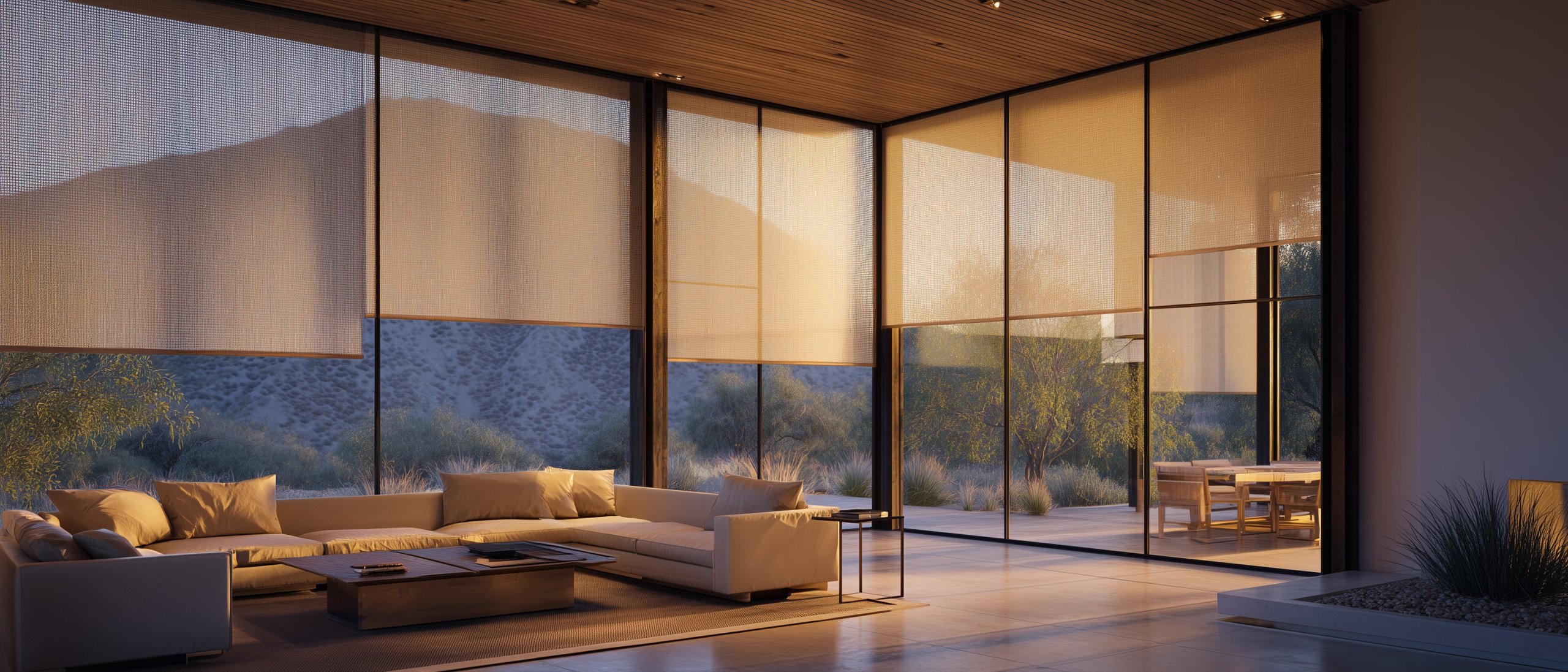
The artificial light is one half of the residence’s lighting. The daylight is the other. The combined system manages both as a single architectural concern: how much natural light enters the space, how it is modulated through shades or dynamic glass, how the artificial light supplements or replaces it as the day progresses, and how the family’s patterns are reflected in what is on, what is off, and what is at what intensity at any given moment. At sovereign-estate scale this is not a lighting control system. It is the substrate that produces what the residence feels like every hour of every day.
Two technological shifts have changed the lighting and shades category over the last decade. The first is the displacement of incandescent and halogen by LED, which has changed what dimming actually requires — no longer simple resistive control, but more sophisticated digital protocols matched to driver electronics. The second is the maturation of dynamic glass: electrochromic panels that change opacity electrically have produced an alternative to motorized shades for certain applications. Both have changed what the architect specifies during design, and both have made the lighting and shades infrastructure more sophisticated than the lighting infrastructure of even a decade ago.
The category is mature, the vendors are established, and the integrator the family engages will likely use the same protocols and platforms that have served high-end residential work for the last generation. What follows treats the four interlocking subsystems — artificial light, motorized shade, dynamic glass, and the scene logic that coordinates them — and the architectural decisions made during design that shape what the system actually is for the next several decades.
The four subsystems
Lighting and shades sorts into four interlocking subsystems that operate together but are specified separately.
Artificial light. The fixtures, drivers, dimmers, and control architecture that produce the residence’s artificial lighting. At sovereign-estate scale, the system spans architectural recessed lighting (cove lighting, downlights, accent), decorative fixtures (pendants, sconces, chandeliers), task lighting, landscape and exterior lighting, and the specialized lighting that specific spaces require (gallery lighting for art, accent lighting for architectural features, performance lighting where the residence has a theater or stage). The control architecture is dominated by DALI — Digital Addressable Lighting Interface — at the high end. Lutron’s HomeWorks line, Crestron’s DigitalLighting, and the upper end of Dynalite (Signify) dominate the integrated-lighting-control market at sovereign-estate scale.
Motorized shades. The mechanical layer that modulates the daylight. Lutron’s Sivoia QS line is the most widely deployed at the high end, with the wired and wireless shade-motor architectures that have set the standard for the category. Hunter Douglas, Coulisse, Mecho, and the European specialists (Warema, Schenker) populate the category alongside. The shade-fabric selection matters operationally — sheer fabrics for daytime privacy and glare control, blackout for sleeping spaces and theaters, dual-shade systems where a single window needs both — and the integrator typically works with the interior designer on the fabric specification alongside the motor and control architecture.
Dynamic glass. The electrochromic panels that change opacity electrically, producing the daylight modulation function shades have served traditionally without the mechanical layer. View Inc., SageGlass (Saint-Gobain), Halio (Kinestral), and Gauzy populate the category. The advantages are real: no shade hardware, no mechanical noise, integration with the building envelope as a single architectural element. The disadvantages are the transition time (minutes to fully tint), the cost (substantially higher than conventional glazing plus shades), and the binary nature of the product — the glass either supports dynamic tinting or it does not, and retrofit is not practical. For substantial expanses of glazing where mechanical shades would be visually intrusive, exterior glazing where weather protection of shade hardware is problematic, or the architectural language the family wants, dynamic glass is increasingly the specified choice.
Scene logic. The control layer that coordinates the other three. The morning scene that opens shades, brings up the breakfast-area lighting, and adjusts the dynamic glass against the sunrise angle. The afternoon scene that closes shades on the south face when the sun crosses the wrong angle and adjusts the interior lighting to compensate. The evening scene that closes shades for privacy, brings up the warm decorative lighting, dims the architectural lighting, and produces what the family experiences as “the evening atmosphere.” The night scene that handles the few lights that remain on, the security-perimeter lighting that activates after sunset, and the dim path lighting that supports late-night movement. The scene logic is the layer the family actually experiences; the other three subsystems are what the scene logic operates against.
DALI as the backbone
The protocol decision that shapes everything else at the upper end is DALI — Digital Addressable Lighting Interface — which has displaced earlier control architectures (0-10V analog, switched zones, low-voltage bus topologies) as the standard for substantial residential and commercial lighting control.
DALI assigns each fixture or driver a unique digital address, with the control bus carrying instructions to specific fixtures rather than to circuits. The implications are substantial: dimming is granular and stable across LED drivers, color temperature is controllable per fixture, fault detection happens at the fixture level rather than at the panel, and the system supports the per-fixture programming the contemporary scene architecture requires. DALI-2 (the current generation) extends the protocol with sensor integration, emergency lighting, and the broader feature set that brings DALI into parity with the proprietary architectures Crestron and Lutron have offered for years.
The choice at sovereign-estate scale is typically not whether to use DALI but how to integrate it with the broader automation backbone (Crestron, Lutron HomeWorks, Savant) the residence operates on. The proprietary stacks include DALI integration; the open-protocol approach builds on DALI directly. Either way, DALI is the protocol the fixtures themselves operate on, and the specification at architectural design determines what is wired into the walls before the rest of the system is built around it.
Lighting and shades is the substrate that produces what the residence feels like every hour of every day. The decisions are made during architectural design and live in the building for decades.
The relationship to EstateAI
Automation executes; EstateAI reasons. For lighting and shades, this means the scene logic is engineered into the automation controllers, with EstateAI determining which scenes activate when based on the household’s actual patterns rather than against programmed schedules alone.
The morning scene at 6:30 a.m. is a programmed schedule the automation runs autonomously. EstateAI knows the principal is in Asia this week and suppresses the morning scene until the household is back in residence. The afternoon shade-close scene on the south face is triggered by the solar-angle calculation the automation handles. EstateAI knows the family is hosting a lunch on the south terrace today and overrides the scene to keep shades open longer than the schedule indicates. The automation maintains its operational integrity if EstateAI is unavailable; the scenes still run on their programmed schedules. What EstateAI adds is the contextual layer the schedule alone cannot have.
How lighting and shades fits within Automation
Lighting and shades sits as the first of four subsystems treated under Automation — alongside Climate, Audio-visual, and Mechanical & access. Across the four, lighting and shades is the most architecturally visible: the family experiences the lighting and the daylight modulation continuously, every hour of every day. It is also the subsystem most directly shaped by architectural design — the fixture locations, the wall and ceiling architecture that supports them, the window placements and the shade-pocket details that hide the hardware. These are decisions made during architectural design and installed during construction, with revision difficult and expensive afterward.
Lighting and shades produces the residence’s atmosphere. At sovereign-estate scale, the system is a combined architectural concern spanning artificial light, daylight modulation through shades or dynamic glass, and the scene logic that coordinates them against the family’s actual patterns. The decisions made at architectural design — the fixture specification, the DALI infrastructure, the shade and glass selections, the scene architecture — shape what the residence feels like for the next several decades. The integrator the family engages will work with the architect and interior designer alongside the broader Automation specification; the subsystem is too consequential to specify after the rest of the build is committed to.