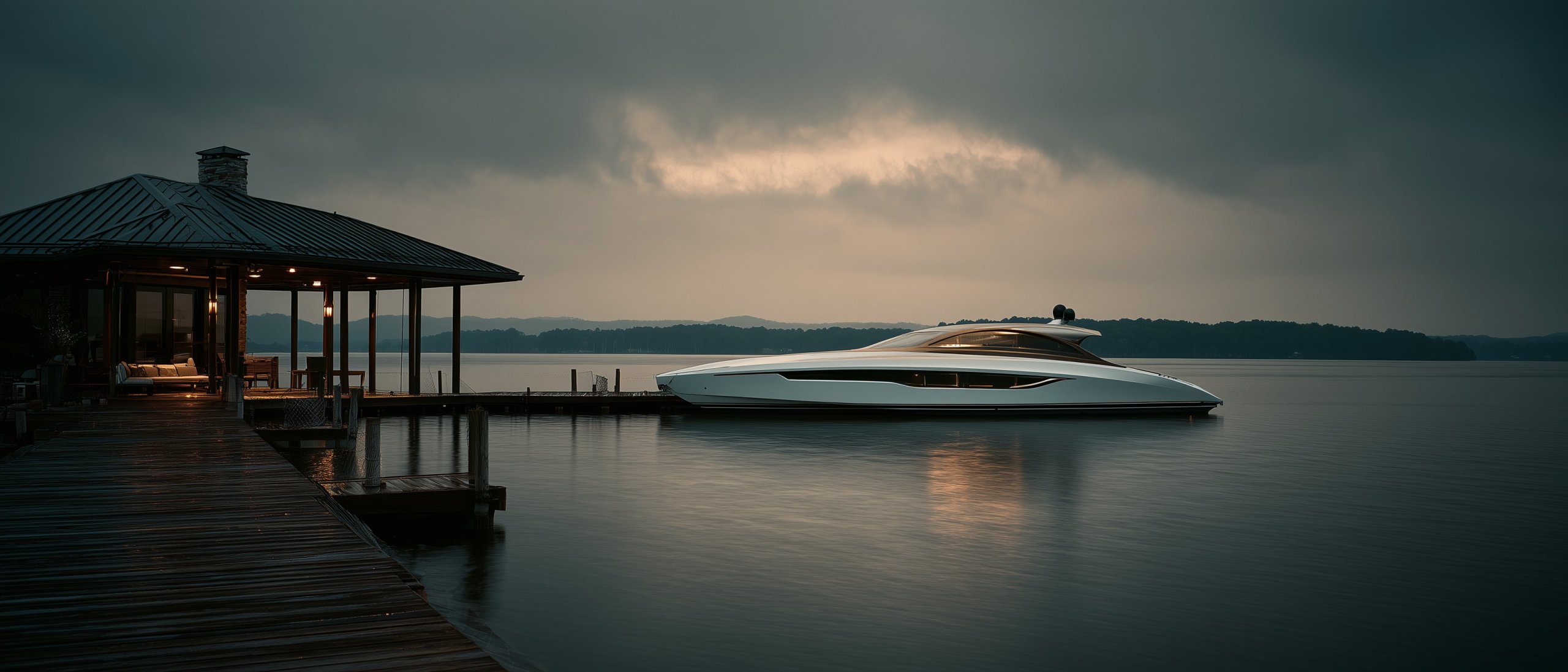
The motor yacht is the principal powered marine vessel — the platform the family lives aboard during extended cruising, hosts on, and operates as a moving residence when the cruising pattern requires extended time afloat. The category is the most operationally consequential in the marine fleet because the motor yacht is where the family actually spends substantial time on the water, where the engineering and operational disciplines are most fully developed, and where the propulsion transition is most genuinely binding. The treatment that follows resolves the category across the size and propulsion spectrum the substantial motor yacht actually operates within.
The motor-yacht size spectrum sorts into roughly three working ranges. The 10–25m range covers larger day-boats, weekend cruisers, and smaller motor yachts that can operate from the estate’s own waterfront as estate-resident vessels. The 25–50m range is the substantial cruising motor yacht — large enough for extended passages and the operational support of dedicated crew, small enough to operate from most substantial marinas and from estates with deep-water frontage. The 50m+ range is the superyacht category proper, where the engineering, crew, and operational reality cross into a different scale of marine operation; vessels at this scale typically operate from marinas rather than from estate waterfronts, with the family accessing them through travel to the vessel’s home port or cruising location.
The propulsion architecture across the motor-yacht fleet is in active transition. The conceptual treatment of that transition sits on Marine; what matters at the motor-yacht level is that different propulsion architectures actually win at different points on the size spectrum, with the build category committed to host multiple architectures across the multi-decade life of the substantial-yacht fleet.
The substantial yards and the build category
The substantial motor yacht is built by the European and selectively global yards operating at the upper end of the build category. The Northern European apex includes Lürssen (Bremen, the substantial superyacht builder operating at the largest scales), Feadship (the Dutch consortium of De Vries and Royal Van Lent, operating at apex semi-custom and custom scales), Oceanco (Dutch, large-yacht specialist), and Heesen (Dutch, full-displacement and fast-displacement specialist). The Italian apex includes Benetti, Sanlorenzo, Codecasa, and Baglietto, operating across the substantial cruising-yacht range. The German specialist Abeking & Rasmussen and the Dutch Amels operate at scale.
The category of explorer yacht — the heavy-duty, long-range vessel engineered for substantial-passage capability and remote-region operation — is increasingly developed at yards including Damen Yachting, whose Xplorer range (60m, 80m, and 105m platforms) defines the contemporary expedition-yacht category. The After You (Xplorer 60) delivered in 2025 represents the recent generation of the category. Each yard operates at its own scale and architectural specialty; the treatment of specific build projects sits on Hospitality showcase where the project bears engineering documentation, and on The yacht under Mobile Estate where the family’s relationship to the platform is the subject.
Hybrid diesel-electric: the dominant new-build configuration
Hybrid diesel-electric is the dominant propulsion architecture for premium motor-yacht new builds across most of the substantial-yacht range. The configuration pairs conventional diesel engines (for extended-passage capability at displacement and semi-displacement speeds) with electric motors and a substantial battery bank (for silent low-speed cruising, hotel loads at anchor, and emissions-free operation in restricted waters).
The operational advantages are load-bearing rather than aspirational. Silent cruising at low speeds — the configuration the family experiences during morning departure from anchor or arrival in a port — is substantively different from diesel-powered low-speed operation. Hotel loads at anchor — the air conditioning, refrigeration, electronics, and broader hotel infrastructure the vessel runs while stationary — operate off the battery bank rather than off a generator, producing silent operation overnight without the diesel-generator noise that historically dominated anchored-yacht acoustics. Emissions-free operation in restricted waters extends the vessel’s operational envelope in regulatory environments diesel-only operation does not.
The hybrid is not the future configuration; it is the dominant new-build configuration now. The diesel and the electric both do real work in the same vessel, and the architecture has matured into the operational standard for premium motor yachts.
All-electric at the catamaran scale
Fully electric motor-yacht operation is established at smaller and mid-size scales, with the all-electric catamaran segment specifically reaching substantial commercial maturity. The catamaran hull form is structurally favorable for electric propulsion: the wide deck area supports substantial solar augmentation, and the relatively low-drag hull form requires less propulsion power per unit of distance than monohull equivalents.
The substantial all-electric catamaran builders include Sunreef Yachts (the ULTIMA range of all-electric catamarans, with the broader Sunreef portfolio across electric and hybrid configurations), Silent Yachts (Austria-based, solar-electric catamarans across multiple size ranges), Rossinavi (Italian, with the Sea Cat all-electric catamaran), ALVA Yachts (the Ocean Eco range), and the broader dozen-plus builders operating in the category. The segment is genuinely commercial, with multiple builds across multiple operating regions and continuous evolution of the propulsion and battery architecture as the technology matures.
Methanol fuel cells at the apex
Methanol fuel cells and hydrogen are entering at the largest yacht scales as the first plausible answer to the energy-density question that pure electric cannot solve for serious cruising vessels at the substantial-superyacht scale. Feadship’s Breakthrough (launched 2025 at 118.8m, the first hybrid superyacht with a hydrogen fuel cell installation alongside its hybrid diesel-electric architecture) represents the current frontier; the broader methanol and hydrogen R&D at Lürssen, Feadship, and the apex yards defines the trajectory the category is on across the next decade.
The engineering point is that pure battery electric cannot match diesel’s energy density at the scale required for multi-week passages by a 70m+ vessel; fuel cells (with methanol or hydrogen as the energy carrier) are the architecture that produces low-emissions operation without the energy-density compromise. The methanol-fuel-cell frontier is at the build level rather than at the operational-fleet level — the production fleet remains hybrid diesel-electric and will for a substantial period.
Autonomy and operational integration
Motor-yacht autonomy is Level 2 (assisted piloting) rather than fully autonomous, with the current technology generation led by Avikus (the HD Hyundai subsidiary) and its NEUBOAT Control platform, alongside integration partnerships with Honda Marine and Raymarine. The capabilities deliver real workload reduction — automated docking, real-time collision avoidance, adaptive cruise control, station-keeping at anchor — without removing the certified-officer watch requirement.
The estate-side integration matters for the motor yacht that operates from the estate’s own waterfront: dock-side telemetry visible at the operations console, charging-state integration with the estate’s energy substrate, and the broader security and operational architecture that extends to the waterfront. The conceptual treatment of marine autonomy sits on Marine; what matters at the motor-yacht level is that the substantial-yacht fleet engages with Level 2 autonomy in the routine operational situations where workload reduction is genuinely useful.
The estate-resident and marina-resident split
The motor-yacht category spans the estate-resident and marina-resident boundary directly. The smaller motor yachts (roughly 25m and below) typically operate from the estate’s own waterfront as estate-resident vessels, charging from estate marine infrastructure, maintained through household-managed relationships, and integrated with the estate’s substrate as part of the family’s daily mobility. The substantial motor yachts (roughly 50m and above) typically operate from marinas — the dredged depth, the marina-grade dock infrastructure, and the operational support a substantial vessel requires exceed what most private waterfronts can support. The mid-range (25–50m) varies by site geography; estates with natural deep-water frontage can support vessels in this range, estates without cannot.
The conceptual treatment of this distinction sits on Marine; what matters at the motor-yacht level is that the propulsion mix, the engineering, and the operational architecture vary across the size spectrum and across the estate-resident-versus-marina-resident boundary. The waypoint architecture that supports the marina-resident superyacht is treated on Waypoint memberships under Destination.
How motor yachts fit within Marine
Motor yachts is the first of three sub-categories of Marine, alongside Sailing yachts and Day boats & tenders. Across the three, motor yachts is the category where the family’s substantial-cruising marine presence actually operates — the platform the family lives aboard for extended passages, the moving residence for the seasonal rotation, the vessel that anchors the broader marine fleet.
The propulsion transition runs most visibly across this category — diesel still standard for serious cruising, hybrid dominant in new builds, all-electric established at the catamaran scale, methanol fuel cells entering at the apex. The architectural observation is that the motor-yacht category is in genuine propulsion transition, with multiple architectures operating commercially at different points on the size spectrum, and the estate’s marine infrastructure committed to host all of them across the multi-decade life of the family’s marine fleet.