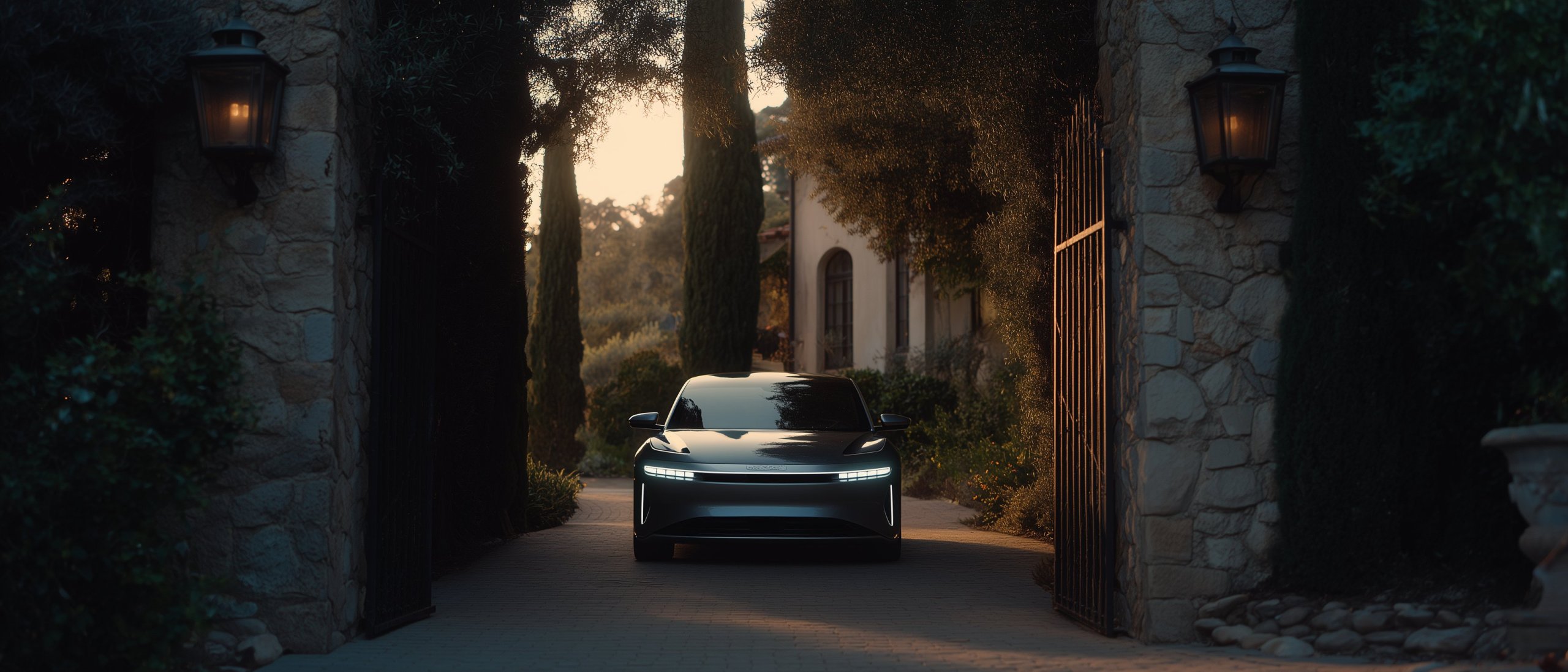
What “working fleet” means at the estate level
The working fleet is the category of vehicles the household operates for transportation tasks the family does not need to drive personally. Guests arriving by air go directly to a vehicle at the curb that drives them to the residence without a chauffeur. Staff transportation from staff residences or off-property quarters to the estate runs as a scheduled service. Multi-residence households move people and supplies between properties on the household’s schedule. Event logistics — shuttling event staff, vendors, or arriving guests during gatherings — happen through the working fleet rather than through hired drivers or family vehicles.
The acquisition logic is operational, not personal. The principal who acquires a working fleet vehicle is not choosing a vehicle the family will ride in for the pleasure of being driven; they are specifying infrastructure for the household’s transportation work. The vehicle does not need to flatter the family the way the cars in the garage do. It needs to handle its tasks reliably, integrate with the estate’s operations, and accommodate the people it carries appropriately. The purpose-built nature of the category — vehicles designed for fleet operation rather than for personal driving — matches this acquisition logic. The Cybercab is not a competitor to the family’s personal vehicle; it is a different category serving a different purpose.
The platform classes
Two platform classes anchor the working fleet category in 2026.
Purpose-built robotaxi platforms are vehicles engineered from scratch for autonomous fleet operation. The two production-stage examples are Tesla Cybercab (two-passenger, no steering wheel or pedals, entering volume production in 2026 at Gigafactory Texas) and Zoox (four-passenger bidirectional pod with carousel-style face-to-face seating and subway-style sliding doors, in commercial service in Las Vegas and San Francisco). Both vehicles share the structural commitment: no driver controls, no driver seat, no driver. The vehicle is the fleet member, not a converted personal vehicle. The category is moving rapidly — multiple additional manufacturers are in development with purpose-built platforms expected across 2027 and 2028.
Autonomous shuttle vans are larger-capacity vehicles handling group transportation. The category overlaps with airport shuttles, hotel transportation, campus mobility, and similar use cases. Most current platforms are conversions of existing van bodies (May Mobility, Holon, Continental joint ventures, others), with purpose-built shuttle architectures emerging behind the smaller robotaxi platforms. For sovereign estates with substantial event traffic, large staff operations, or extended-family households, the shuttle category fills the capacity gap the smaller robotaxi platforms cannot.
The 2026 reality
The purpose-built robotaxi category materially changed in early 2026. The first production Tesla Cybercab rolled off the Gigafactory Texas line on February 17, 2026, with volume production starting in April. Target pricing is in the $25,000-$30,000 range — substantially below the family’s personal vehicles, reflecting the simplified architecture and the fleet-operation use case. The Cybercab is self-certified Level 4 for fleet operation, with Tesla’s commercial robotaxi service targeted to launch in Austin in late 2026 once federal regulatory exemptions for the steering-wheel-free design are completed. Long-term Tesla production targets are 2 million units per year at full capacity across multiple factories.
Zoox has been operating commercial robotaxi service in Las Vegas since September 2025 (on the Strip) and in San Francisco since November 2025 (initially in SoMa, expanding to the Marina, North Beach, Chinatown, and the Embarcadero in spring 2026). The Amazon-owned platform completed nearly two million autonomous miles and carried more than 350,000 riders across its first six months of commercial operation. Expansion to Austin and Miami is in initial rollout as of early 2026. Zoox operates approximately 50 vehicles across its initial markets; the fleet is scaling deliberately.
Waymo dominates the broader commercial robotaxi market, completing approximately 450,000 paid rides per week across six cities as of early 2026 (Phoenix, San Francisco, Los Angeles, Austin, Miami, and Atlanta), with expansion to ten additional US markets and pilot operations in Tokyo and London announced. Waymo’s service operates through fleet ownership rather than vehicle sale; the platform is not directly acquirable by private owners in the way the Cybercab is, though the service is available in the geographic markets where it operates. The category truth specific to each platform — the technical capability, the autonomy level claims, the commercial timing — is treated in depth elsewhere on the SiliconPlans network.
The owner-deployment question
The Cybercab introduces a structural innovation that distinguishes it from earlier purpose-built robotaxis: Tesla explicitly designed the vehicle for owner-operated commercial deployment. A Cybercab owner can deploy the vehicle in Tesla’s robotaxi network during periods the family does not need it, generating revenue that offsets — potentially substantially — the cost of ownership. The economic case is real: a vehicle utilized at sovereign-estate-personal-use rates is idle approximately 95% of the time. A Cybercab earning fleet utilization during those idle hours is a different financial proposition than a depreciating personal vehicle sitting in the garage.
The decision is not purely financial. Commercial deployment means the family’s vehicle has been carrying paying passengers the household does not know. The vehicle accumulates wear and tear at fleet utilization rates rather than personal-use rates. The privacy posture differs from a dedicated household vehicle. And the family must accept that during the periods of revenue use, the vehicle is not available for unscheduled household needs. For some households, the economics dominate and the deployment is straightforward. For others, the dedicated-household-use posture matches the family’s preferences better, and the vehicle stays out of commercial service entirely. The decision is explicit, made deliberately, and configurable per vehicle in the working fleet.
Infrastructure and integration
The working fleet has different infrastructure requirements than the family’s personal vehicles. Charging architecture must accommodate higher-utilization patterns — the working fleet vehicle charges between trips throughout the day, not overnight after a single daily use. The Cybercab specifically is designed for wireless inductive charging, with pad-based charging stations rather than connector-based ones, simplifying the operation but requiring different infrastructure planning. Parking and staging accommodations differ — vehicles without steering wheels or pedals require different ingress and egress patterns, and the working fleet’s arrival and departure cycles need staging areas that allow autonomous repositioning without manual intervention.
Integration with EstateAI and the operations console matters more for the working fleet than for the family’s personal vehicles. The working fleet is dispatched against the household’s actual transportation needs — guests arriving on specific flights, staff shifts beginning at specific times, events requiring specific shuttle service. EstateAI knows the household’s schedule and pre-positions vehicles accordingly. The operations console shows working fleet utilization and availability at a glance. The integration is what distinguishes a sovereign-estate working fleet from a household that happens to own several robotaxi-style vehicles operating as parallel services.
The decisions worth surfacing
Four decisions in working fleet acquisition warrant principal-level engagement.
Category and capacity selection. Purpose-built robotaxi platforms (Cybercab, Zoox) versus autonomous shuttle vans, and the capacity match against the household’s actual transportation patterns. A household with substantial guest traffic and events benefits from shuttle capacity; a household with primarily staff transportation needs benefits from smaller robotaxi platforms; most sovereign estates with significant operational scale benefit from both classes.
Owner-deployment policy. Whether working fleet vehicles operate in revenue-generating commercial service during idle hours, or stay dedicated to household use. The financial case for revenue use is substantial; the privacy and availability trade-offs are real. The decision is per-vehicle and configurable — the household may dedicate one vehicle to family-only use while deploying others commercially.
Manufacturer mix. Which platforms enter the working fleet, and from how many manufacturers. The single-manufacturer working fleet has integration simplicity but vendor concentration risk. The multi-manufacturer working fleet has architectural diversity but more complex integration with EstateAI. The 2026 market is genuinely early; the working fleet acquired now is the first generation, with substantial supplementation expected across 2028-2029 as additional manufacturers reach production.
Integration depth with EstateAI. Whether the working fleet is dispatched through the estate’s reasoning layer substantively, or operated as parallel vendor-managed services. The integrated approach is what makes the working fleet part of the sovereign-estate operation rather than a collection of robotaxi services the household uses. The integration is set during commissioning of both the vehicles and the broader estate substrate.
EstateOps
The working fleet is operated through the same operations console as the rest of the estate, with EstateAI dispatching against the household’s schedule, security tracking vehicles in motion (particularly important for the working fleet, which is often carrying guests or staff rather than the family directly), and the digital twin holding the fleet’s state and utilization across its life. The category will look substantially different in 2030 than in 2026. Multiple additional purpose-built robotaxi manufacturers will reach production. Autonomous shuttle van architectures will mature. The owner-deployment-in-commercial-use option will be available across more platforms. The working fleet acquired now is the first generation; the architecture that integrates it with the estate’s substrate is what makes the eventual category maturity useful to the household.